The Use of Automated Knowledge in Organisations Project

PROJECT SUMMARY

Absract image with drawings of people grouped within a network diagram

The Use of Automated Knowledge in Organisations Project

Focus Areas: News & Media, Mobilities, Social Services, Health
Status: Completed

Organisations are central to knowledge dissemination and value creation in society, functioning as complex rule systems that deploy knowledge to achieve specific goals. Historically, advances in ICT have enabled organisations to grow and improve efficiency, but their fundamental structure has remained largely unchanged.

Generative AI is a new general-purpose tool that can significantly lower the cost of productive interaction with knowledge by leveraging foundation models for rapid, flexible natural language access. As these models become more complex, their capabilities expand, potentially rivalling large organisations in productivity on some dimensions. This raises the question of whether AI systems will compete with or complement traditional organisations. 

This project investigates the impact of Generative AI on organisational structures and inter-organisational interactions, aiming to develop an AI theory of the firm. It seeks to understand and test how AI-driven systems can be integrated into organisational structures to create what might be termed “artificial organisational intelligence”.

It will investigate the adoption of decentralised AI within organisational contexts and the organisational capabilities required to make effective use of AI. By addressing the challenges of reliability, confidentiality, and contextual accuracy in AI systems, this project will contribute to the development of robust systems that are better suited for organisational use. This could have broad implications for how AI is deployed in various sectors, from business and government to community and environmental initiatives.

PROJECT OBJECTIVES

  • Develop a new theory of the firm relevant to the digital economy, including the role(s) of AI within this transformation.
  • Document, analyse, and compare the constitutive processes that organisations undertake in relation to automated technologies.
  • Produce evidence of how different approaches to AI governance within organisations influence the capabilities of organisations both individually and as networks of organisations.
  • Compare the performance of standard AI tool usage with customized modifications, exploring how these modifications contribute to organizational capabilities, including efficiency, accuracy, and social innovation.

RESEARCHERS

Ellie Rennie

Prof Ellie Rennie

Project Co-Leader and Associate Investigator,
RMIT University

Learn more

ADM+S Chief Investigator Jason Potts

Prof Jason Potts

Project Co-Leader and Chief Investigator,
RMIT University

Learn more

Mark Andrejevic

Prof Mark Andrejevic

Chief Investigator,
Monash University
Learn more

ADM+S Associate Director Jean Burgess

Dist Prof jean Burgess

Chief Investigator,
QUT

Learn more

ADM+S Chief Investigator Anthony McCosker

Prof Anthony McCosker

Chief Investigator,
Swinburne University
Learn more

Kelsie Nabben

Dr Kelsie Nabben

Research Fellow,
RMIT University
Learn more

Brooke Coco

Brooke Ann Coco

PhD Student,
RMIT University

Learn more

Annette Markham

Prof Annettee Markham

Affiliate,
Utrecht University

Learn more

Michael Zargham

Dr Michael Zargham

Industry Partner,
BlockScience and Metagov

Learn more

COLLABORATORS

BlockScience logo

BlockScience

Visit website

Metagov Logo

Metagov

Visit website

AI ReWired: How communities are using AI to Support Social and Environmental Justice

PROJECT SUMMARY

A persons neck wearing a microship necklace

AI ReWired: How communities are using AI to Support Social and Environmental Justice

Focus Areas: News & Media, Mobilities, Health
Research Program: People
Status: Completed

The future we are being sold is an automated wonderland, a techtopia that will use algorithms to heal our ecological crisis and restore social justice. A dream world where we enjoy endless innovation and growth in sparkling smart cities, where we are liberated from the burden of work, where the future of our species lies in billionaire funded missions to Mars.

But what if this promise sounds more like a nightmare?
What are the alternatives?

The AI ReWired project uses co-creative documentary film practice to uncover how diverse communities utilise AI systems to protect the environment, support social justice and promote fairness in their communities.

RESEARCHERS

Jeni Lee

Jeni Lee

Lead Investigator,
Monash University

Learn more

ADM+S Chief Investigator Sarah Pink

Prof Sarah Pink

Chief Investigator,
Monash University

Learn more

Dr Damiano Spina

Dr Damiano Spina

Associate Investigator,
RMIT University

Learn more

Yolande Strengers

Prof Yolande Strengers

Associate Investigator,
Monash University

Learn more

Georgia Van Toorn

Dr Georgia van Toorn

Associate Investigator,
UNSW

Learn more

Thao Phan

Dr Thao Phan

Research Fellow,
Monash University

Learn more

Emma Quilty

Dr Emma Quilty

Affiliate,
Monash University

Learn more

Melissa Gregg

De Mel Gregg

Senior Industry Fellow,
RMIT

Learn more

Nonie May

Dr Nonie May

Project support,
Monash University

Learn more

Humans, Machines, and Decision Responsibility

PROJECT SUMMARY

Businessman using cell phone on subway train

Humans, Machines, and Decision Responsibility

Focus Areas: News & Media, Social Services, Mobilities, Health
Research Program: Institutions, Machines
Status: Completed

Automated decision-making provokes a range of anxieties around transparency, equality, and accountability. A key response has been the call to ‘re-humanise’ automated decisions, with the hope that human control of automated systems might defend human values from mindless technocracy. Regulation of automated decision-making and AI often embeds this form of human centrism by prescribing a ‘human in the loop’ and the need for automated decisions to be ‘explained’. These requirements are central elements of the risk-based approaches AI regulation currently in development.

Despite their intuitive appeal, empirical research is revealing the limitations and complexities of these approaches. AI explanations sometimes provide little that is useful for decision subjects or decision makers, and risk distracting from more meaningful interrogation of why decisions are made. A human in the loop sometimes functions as a rubber stamp for automated decisions, cleaving accountability away from the true sites of decision responsibility.

This project seeks to generate better understandings of the functions, capacities, and normative role of humans within automated decision systems. It will investigate the ways that automated systems ought to explain or be explained to humans within decision processes, and how elements of decision-making including processes, responsibility, authority, and what counts as a decision itself, are fragmented and redistributed between humans, machines, and organisations. The goal is to generate empirical knowledge of how automated systems, humans, and organisations interact in different contexts when making decisions, and to move past outdated understandings of decisions-making that are hindering effective governance of automation in new decision contexts.

RESEARCHERS

Jake Goldenfein

Dr Jake Goldenfein

Lead Investigator,
University of Melbourne

Learn more

ADM+S Associate Director Jean Burgess

Prof Jean Burgess

Chief Investigator,
QUT

Learn more

Paul Henman headshot

Prof Paul Henman

Chief Investigator,
University of Queensland

ADM+S Chief Investigator Christopher Leckie

Prof Chris Leckie

Chief Investigator,
University of Melbourne

Learn more

Prof Flora Salim

Prof Flora Salim

Chief Investigator,
UNSW

Learn more

Distinguished Professor Julian Thomas

Prof Julian Thomas

Chief Investigator,
RMIT University

Learn more

Kim Weatherall

Prof Kim Weatherall

Chief Investigator,
University of Sydney

Learn more

Henry Fraser

Dr Henry Fraser

Research Fellow,
QUT

Learn more

Awais Hameed Khan profile image

Dr Awais Hameed Khan

Research Fellow,
UQ

Learn more

Fan Yang

Dr Fan Yang

Research Fellow,
University of Melbourne

Learn more

Libby Young

Libby Young

PhD Student
University of Sydney

Learn more

Joe Brailsford

Joe Brailsford

Affiliate
University of Melbourne

Learn more

Fabio Mattioli

Dr Fabio Mattioli

Affiliate
University of Melbourne

Learn more

Christopher O'Neill

Dr Chris O’Neil

Affiliate,
Deakin University

Learn more

Ash Watson

Dr Ash Watson

Affiliate,
UNSW

Learn more

Is Pricing Discriminatory: Testing Automated Decision-Making Systems in Online Insurance Markets

PROJECT SUMMARY

man and women working on laptop together

Is Pricing Discriminatory: Testing Automated Decision-Making Systems in Online Insurance Markets

Focus Areas: News & Media, Social Services, Mobilities, Health
Research Program: Data
Status: Completed

Advances in data-driven and AI systems are driving significant transformation in the emerging insurance technology (insurtech) sector.

This project investigates the extent to which automated decision-making systems impact the provision of consumer insurance via pricing algorithms which may produce unfair outcomes for particular subsets of society by engaging in proxy and price discrimination.

RESEARCHERS

Kelly Lewis

Dr Kelly Lewis

Lead Investigator,
Monash University

Learn more

Mark Andrejevic

Prof Mark Andrejevic

Chief Investigator,
Monash University

Learn more

Daniel Angus

Prof Daniel Angus

Chief Investigator,
QUT

Learn more

Kim Weatherall

Prof Kim Weatherall

Chief Investigator,
University of Sydney

Learn more

Zofia Bednarz

Dr Zofia Bednarz

Associate Investigator,
University of Sydney

Learn more

Jathan Sadowski

Dr Jathan Sadowski

Associate Investigator,
Monash University

Learn more

ADM+S professional staff Abdul Obeid

Dr Abdul Obeid

Data Engineer,
QUT

Learn more

PARTNERS

CHOICE

Visit website

Consumer Policy Research Centre Logo

Consumer Policy Research Centre

Visit website

Automation and Public Space

PROJECT SUMMARY

LiDAR sensing concept

Automation and Public Space

Focus Areas: News and Media, Transport and Mobility, Health, and Social Services
Research Program: Data
Status:
 Completed

From delivery drones to digital twins to crowd surveillance, automated decision-making technologies and practices are increasingly impacting public and shared space. This project investigates how automated decision-making systems impact public and shared space via sensors that produce actionable digital simulations, artefacts, and interfaces. Through a mixed methods approach, it will examine current and potential effects of automated decision-making on the form, use, and experience of public space.

Technological development in this area is undergoing rapid change. Delivery via autonomous drone requires sensor-driven navigation systems, but the data and models they produce about public space will likely lead to modulations of that space in response. In urban and environmental governance, ‘digital twins’ are increasingly to monitor environments in real-time, simulate the impact of potential changes, and even implement those changes directly. Technologies such as these are not only increasingly deployed in Australia, but are also invented, designed, and tested here too, often in proximity to defence and defence industries.

Understanding how tools of automated spatiality reconfigure environments and the role of policy and industry in their innovation and uptake will generate new knowledge about a critical point of convergence between public space, technology, defence, and industry with national significance, as well as implications for international jurisdictions facing similar changes and challenges.

Over 3 years commencing in 2022, the project aims to answer the following questions:
• How is space-making automated across different technologies and contexts? What logics, techniques and practices are shared? What are distinct to different contexts?
• How does automated spatiality lead to the reconfiguring of public space?
• How are digital infrastructures, such as unmanned traffic management systems for civilian airspace, imagined, organised, and regulated?
• How do policy settings, industrial demands, and defence priorities shape the development and application of technologies of automated spatiality?

PUBLICATIONS

Andrejevic, M.

Journal article

Biometric Re-bordering: Environmental Control During Pandemic Times, 2022

Andrejevic, M., Volcic, Z.

Journal article

Seeing Like a Border, 2021

Andrejevic, M., Volcic, Z.

Journal article

RESEARCHERS

Michael Richardson

Assoc Prof Michael Richardson

Lead Investigator,
UNSW

Learn more

Mark Andrejevic

Prof Mark Andrejevic

Chief Investigator,
Monash University

Learn more

Jake Goldenfein

Dr Jake Goldenfein

Chief Investigator,
University of Melbourne

Learn more

ADM+S Chief Investigator Anthony McCosker

Prof Anthony McCosker

Chief Investigator,
Swinburne University

Learn more

Jathan Sadowski

Dr Jathan Sadowski

Associate Investigator,
Monash University

Learn more

Rowan Wilken

Assoc Prof Rowan Wilken

Associate Investigator,
RMIT University

Learn more

Zoe Horn

Zoe Horn

Student,
Western Sydney University

Learn more

Lauren Kelly

Lauren Kelly

Student,
RMIT University

Learn more

Andrew Brooks

Dr Andrew Brooks

Affiliate,
UNSW

Learn more

Danielle Hynes

Danielle Hynes

Affiliate,
UNSW

Learn more

Kelly Lewis

Dr Kelly Lewis

Affiliate,
Monash University

Learn more

Thao Phan

Dr Thao Phan

Affiliate,
ANU

Learn more

Christopher O'Neill

Dr Chris O’Neill

Affiliate,
Deakin University

Learn more

PARTNERS

OVIC Logo

Office of the Victorian Information Commissioner

Learn more

Designing Automated Tools to Support Welfare Rights Advocacy

PROJECT SUMMARY

Person typing on laptop with graphic overlay

Designing Automated Tools to Support Welfare Rights Advocacy

Focus Areas: Social Services
Research Program: Machines
Status: Completed

Welfare rights lawyers across Australia advocate for claimants of income support payments (e.g., unemployment benefits, disability support pension, family tax benefit etc.) paid by Services Australia — Centrelink. Claimants rely on welfare payments as a substantive part of their income, and often depend on welfare rights organisations to assist them in disputing decisions by Centrelink. These disputes can range from alleged debt due to overpayment, cessation of payment, or denial of payment altogether.

When engaging a client to support a dispute claim, welfare rights lawyers often submit a Freedom of Information (FOI) request to Centrelink, to access client files. Centrelink provides this information in the form of a large PDF document (colloquially referred to as THE BRICK), which contains hundreds of pages of client data, including case notes and screenshots from Centrelink computers, documents using a lot of system and internal acronyms. Lawyers must then trawl through and make sense of this detailed document, reconstructing the history of a client’s case, while attempting to decipher the decisions made by Centrelink and their rationale. This is a heavy time consuming and onerous process, reducing the actual time a lawyer spends in engaging with their client, and making the legal arguments for the case.

Working closely with welfare rights lawyers (and their teams), advocacy groups, and users of social services — this project aims to collaboratively design, prototype, and pilot an automated data extraction tool to support welfare rights lawyers in making sense of Services Australia (Centrelink) system-generated FOI documents.

This project explores the following research questions:

  1. How can we digitally scaffold and support sense-making of Freedom of Information (FOI) system-generated responses through a data extraction tool outside the government system?
  2. What methods/approaches can facilitate collaborative design of Automated Decision-Making (ADM) support systems in social services with key stakeholders?
  3. How might we reclaim and democratize sense-making/deciphering of government ADM outputs from outside of government systems — designing for controlled activism?
  4. What impact can using an ADM support system, such as the data extraction tool, have on an organisational work flow and capacity of welfare rights lawyers to support their clients?

Key objectives are to:

  • Design, prototype and build an automated data extraction tool to support welfare rights lawyers in sense-making of system-generated FOI documents
  • Involve welfare rights lawyers, advocacy groups, and social service users and professionals in co-design of ADM tools to support such sense-making
  • Evaluate the Implications of the tool on organisational practice and processes

RESEARCHERS

Paul Henman headshot

Prof Paul Henman

Lead Investigator,
University of Queensland

Terry Carney profil picture

Prof Terry Carney

Associate Investigator,
University of Sydney

Learn more

Robert Mullins profile picture

Dr Robert Mullins

Associate Investigator,
University of Queensland

Learn more

Awais Hameed Khan profile image

Dr Awais Hameed Khan

Research Fellow,
University of Queensland

Learn more

Madeline Kelly

Madeline Kelly

Masters Student,
UQ

Learn more

ADM+S professional staff Abdul Obeid

Dr Abdul Obeid

Data Engineer,
QUT

Learn more

Dan Tran

Dan Trang

Software Developer,
QUT

Learn more

PARTNERS

Economic Justice Australia

Economic Justice of Australia

Visit website

Services Australia

Services Australia

Visit website

Welfare Rights Centre

Welfare Rights Centre

Visit website

Trauma-informed AI: Developing and testing a practical AI audit framework for use in social services

PROJECT SUMMARY

Woman's face with artificial intelligence graphic on right side

Trauma-informed AI: Developing and testing a practical AI audit framework for use in social services

Focus Areas: Social Services
Research Program: Machines
Status: Completed

Artificial Intelligence (AI) is increasingly being used in the delivery of social services. While it offers opportunities for more efficient, effective and personalised service delivery, AI can also generate greater problems, reinforcing disadvantage, generating trauma or re-traumatising service users.

Conducted by a multi-disciplinary research team with extensive expertise in the intersection of social services and digital technology, this project seeks to co-design an innovative AI trauma-informed audit framework to assess the extent to which an AI’s decisions may generate new trauma or re-traumatise.

The value of a trauma-informed AI audit framework is not simply to assess digital technologies after they are built and in operation, but also to inform designs of digital technologies and digitally enabled social services from their inception.

It will be road-tested using multiple case studies of AI use in child/family services, domestic and family violence services, and social security/welfare payments.

PUBLIC RESOURCES

Building a Trauma-Informed Algorithmic Assessment Toolkit

Target audience: Social service organisations

This Toolkit has been designed to assist organisations in their use of automation in service delivery at any stage of their automation journey: ideation; design; development; piloting; deployment or evaluation. While of particular use for social service organisations working with people who may have experienced past trauma, the tool will be beneficial for any organisation wanting to ensure safe, responsible and ethical use of automation and AI.

View toolkit

RESEARCHERS

Paul Henman

Prof Paul Henman

Lead Investigator,
University of Queensland

ADM+S Investigator Philip Gillingham

Dr Philip Gillingham

Associate Investigator,
University of Queensland

Learn more

Lyndal Sleep profile picture

Dr Lyndal Sleep

Affiliate,
Central Queensland University

Learn more

Suzanna Fay

Dr Suzanna Fay

Senior Lecturer,
University of Queensland

Learn more

PARTNERS

University of Notre Dame-IBM Tech Ethics Lab

University of Notre Dame-IBM Tech Ethics Lab

Visit website

Mapping automated decision-making tools in administrative decision-making in NSW

PROJECT SUMMARY

In motion people walking by office building

Mapping automated decision-making tools in administrative decision-making in NSW

Focus Areas: Social Services
Research Program: Institutions
Status: Completed

The project is a partnership between ADM+S and the New South Wales Ombudsman to map and analyse the use of automated systems in state and local government sectors in New South Wales (NSW). The project follows from a ground-breaking report on the use of technology in government decision-making published by the NSW Ombudsman in 2022.

The project will first map where and how NSW state and local government agencies are using automated systems in administrative decision processes. This is the first attempt to undertake such a systematic mapping in any jurisdiction in Australia and one of the very few attempts across the world. This first stage, led by Prof Paul Henman, Chief Investigator at ADM+S, and Dr Lyndal Sleep, Research Fellow at ADM+S, will distribute questionnaires and conduct targeted interviews with NSW state and local government agencies; building on the work from the ‘Mapping ADM in Australian Social Services’ project which mapped the use of automated systems in social security settings in Australia.

The second part of the research will be led by ADM+S Chief Investigator Prof Kimberlee Weatherall, and ADM+S Research Fellow Dr José-Miguel Bello y Villarino, which will analyse the different systems planned and in use by NSW public authorities, and the key risks and issues that emerge.

Researchers from ADM+S and Macquarie University will contribute to different legal and technical elements of the project.

The NSW Ombudsman will table a report to NSW Parliament with the findings of the research by the end of 2023.


This project culminated in the release of ‘Automated decision-making in New South Wales: mapping and analysis of the use of ADM systems by State and Local governments’, a report published in partnership with ADM+S and the New South Wales Ombudsman.

The report findings were presented as evidence during the first hearing of the NSW Artificial Intelligence Inquiry at Parliament House in Canberra on 8 March 2024.

Listen to Chief Researcher Prof Paul Henman on the ADM+S Podcast.

RESEARCHERS

Kimberlee Weatherall

Prof Kimberlee Weatherall

Chief Researcher, University of Sydney

Learn more

Paul Henman

Prof Paul Henman

Chief Researcher, UQ

Learn more

José-Miguel Bello y Villarino

Dr José-Miguel Bello y Villarino

Principal Researcher, University of Sydney

Learn more

ADM+S Member

C. Allan

Principal Project Officer, NSW Ombudsman’s Office

ADM+S Member

K. Whitworth

Senior Project Officer, NSW Ombudsman’s Office

Lyndal Sleep profile picture

Dr Lyndal Sleep

Associate Researcher,
Central Queensland University

Learn more

Jenny van der Arend

Dr Jenny van der Arend

Senior Research Assistant, UQ

Learn more

Jeffrey Chan

Assoc Prof Jeffrey Chan

Associate Researcher

Learn more

Terry Carney

Prof Terry Carney

Senior Researcher, University of Sydney

Learn more

Scarlet Wilcock

Dr Scarlet Wilcock

Associate Researcher, University of Sydney

Learn more

Rita Matulionyte

Dr Rita Matulionyte

Associate Researcher, Macquarie University

Learn more

Distinguished Professor Julian Thomas

Dist. Prof Julian Thomas

Advisory Board Member, RMIT University

Learn more

PARTNERS

NSW Ombudsman

Visit website

Risk, Rule-setters and Rule-takers: Regulatory approaches to risk in AI-supported and AI-automated decision-making for general welfare

PROJECT SUMMARY

Crowd in motion in busy precinct

Risk, Rule-setters and Rule-takers: Regulatory approaches to risk in AI-supported and AI-automated decision-making for general welfare

Focus Areas: News and Media, Transport and Mobility, Health, and Social Services
Research Programs: Institutions
Status: Completed

This project seeks to scope several approaches to deal with Automated Decision-Making and Decision-Support Systems-Related Risks (ADM/DSS RR) through norms and provide an evaluation of those approaches for their consideration in regulatory contexts.

The standpoint is to look at risk control of those systems beyond ethics or social principles and focus the discussion on the possible interventions from the regulator’s perspective.

The overarching questions and sub-questions guiding this project are:

  • What is risk in an ADM / DS System?
    – Is it possible to define it?
    – How is it different from technological risk?
    – How is it different from the concept of risk in
    management?
    – Are all “potential harms” risks of and ADM/DSS?
    – Is there a concept of risk usable for regulatory
    purposes?
  • What types of risks are common and which ones specific to ADM/DSS?
    – Due to the nature of the risk?
    – Due to the scale of the risk?
  • What is an acceptable risk:
    – From the point of view of society as a whole
    – From the point of view of the most vulnerable groups
    – From the point of view of the owner of the AI system
    – From the point of view of the users of the system
  • Can risk be separated from questions of liability/ responsibility or do they need to be regulated together?

PUBLICATIONS

Acceptable risks in Europe’s Proposed AI Act: Reasonableness and other principles for deciding how much risk management is enough, 2023

Bello y Villarino, J.M., Fraser, H.

Journal article

The Tale of Two Automated States: Why one-size-fits-all approach to administrative law reform to accommodate AI will fail, 2023

Bello y Villarino, J.M.

Book chapter

International Human Rights, Artificial Intelligence, and the Challenge for the Pondering State: Time to Regulate? 2022

Bello y Villarino, J.M., et al.

Journal article

Legal Issues Around Autonomous Systems – Civil Liability, Fault and System Safety, 2022

Fraser, H.

Conference paper

AI Opacity and Explainability in Tort Litigation, 2022

Snoswell, A., Fraser, H., Simcock, R.

Conference paper

Where residual risks reside: A comparative approach to art 9(4) of the EU’s Proposed AI Regulation, 2021

Bello y Villarino, J.M, Fraser, H.

Working paper

RESEARCHERS

Kimberlee Weatherall

Prof Kimberlee Weatherall

Chief Investigator,
University of Sydney

Learn more

ADM+S Chief Investigator Nic Suzor

Prof Nicolas Suzor

Chief Investigator,
QUT

Learn more

José-Miguel Bello y Villarino

Dr José-Miguel Bello Villarino

Research Fellow,
University of Sydney

Learn more

Henry Fraser

Dr Henry Fraser

Research Fellow,
QUT

Learn more

PARTNERS

Gradient Institute logo

Gradient Institute

Learn more

The Toxicity Scalpel: Prototyping and evaluating methods to remove harmful generative capability from foundation models

PROJECT SUMMARY

Person with colourful text overlay

The Toxicity Scalpel: Prototyping and evaluating methods to remove harmful generative capability from foundation models

Focus Areas: News and Media
Research Programs: Machines
Status: Completed

AI language models have made significant strides over the past few years. Computers are now capable of writing poetry and computer code, producing human-like text, summarising documents, engaging in natural conversation about a variety of topics, solving math problems, and translating between languages.

This rapid progress has been made possible by a trend in AI development where one general ‘foundational’ model is developed (usually using a large dataset from the internet) and then adapted many times to fit diverse applications, rather than beginning from scratch each time.

This method of ADM development can appear time and cost effective, but ‘bakes in’ negative tendencies like the creation of toxic content, misogyny, or hate speech at the foundational layer, which subsequently spread to each downstream application.

The goal of this project is to examine how language models used in ADM systems might be improved by making modifications at the foundation model stage, rather than at the application level, where computational interventions, social responsibility, and legal liability have historically focussed.

PUBLICATIONS

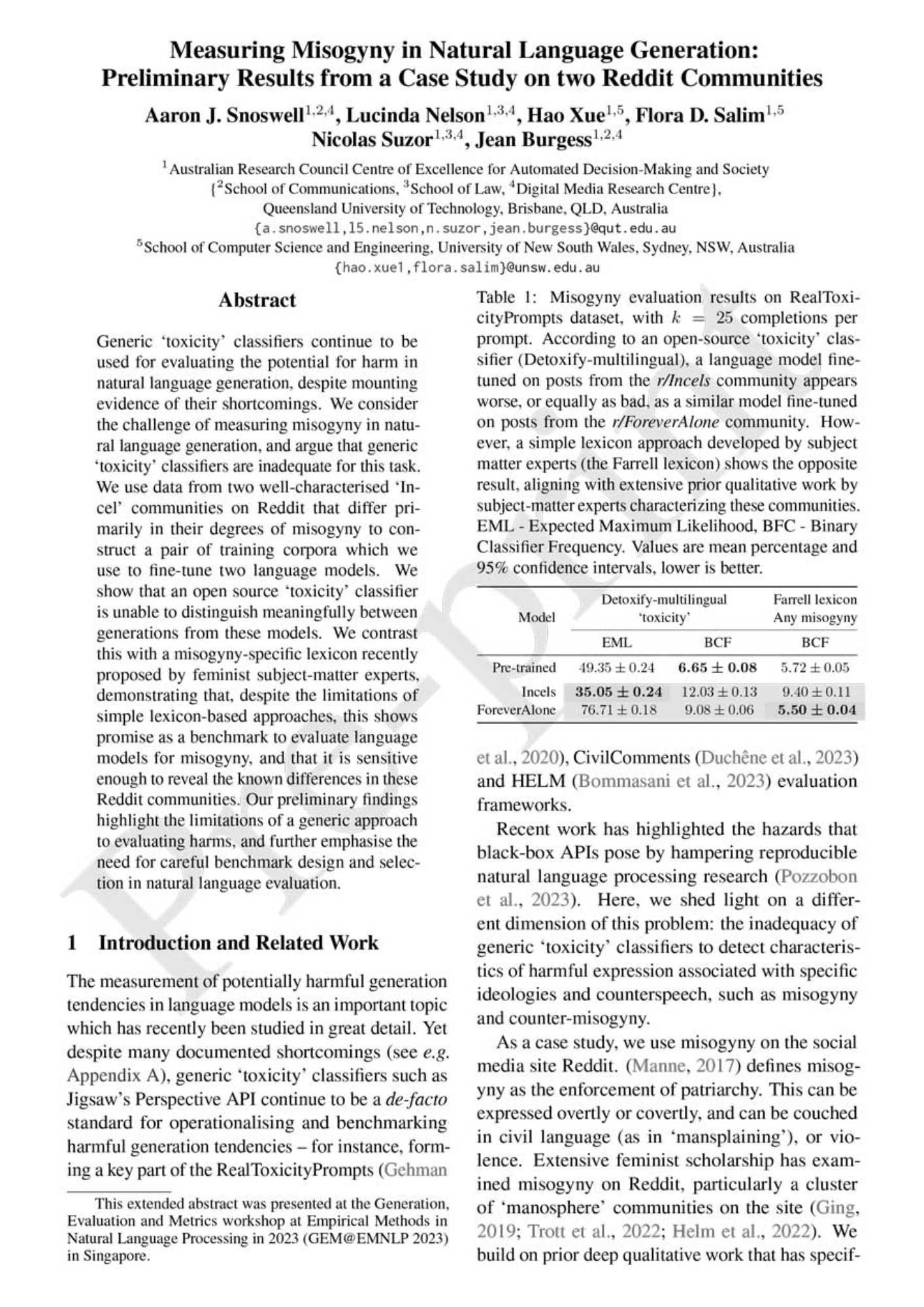
First page of Journal Article: Measuring Misogyny in Natural Language Generation: Preliminary Results from a Case Study on two Reddit Communities

Measuring Misogyny in Natural Language Generation: Preliminary Results from a Case Study on two Reddit Communities,2023

Snoswell, A., Nelson, L., Xue, H., Salim, F., Suzor, N., & Burgess, J.

Journal article

RESEARCHERS

ADM+S Investigator Flora Salim

Prof Flora Salim

Chief Investigator,
UNSW

Learn more

ADM+S Chief Investigator Nic Suzor

Prof Nic Suzor

Chief Investigator,
QUT

Learn more

Dr Aaron Snoswell

Dr Aaron Snoswell

Associate Investigator,
QUT

Learn more

Hao Xue

Dr Hao Xue

Associate Investigator,
UNSW

Learn more

Lucinda Nelson

Lucinda Nelson

PhD Student,
QUT

Learn more

Big Data, Sexual Surveillance and Alternative Governance

PROJECT SUMMARY

Woman using ipad in bed

Big Data, Sexual Surveillance and Alternative Governance

Focus Area: Health
Research Programs: Institutions
Status: Completed

The contested governance of sexual technologies – from apps and platforms to bots and devices – provides a unique case study through which to identify current problems in automated decision-making and to generate new principles, values and approaches. This project will examine existing practices in the collection and use of sexual data by both private and public actors.

It will investigate how algorithms are taught to understand sex, gender and sexuality through digital proxies and their potential to amplify discrimination. It will explore alternative frameworks for governing sexual technologies, including collective approaches to content moderation and data governance.

PUBLICATIONS

High Risk Hustling: Payment Processors Sexual Proxies and Discrimination by Design (2023)

Dr Zahra Stardust, Danielle Blunt, Gabriella Garcia, et al.

Journal article

Submission to the Meta Oversight Board RE Gender, Identity and Nudity (2023)

Dr Zahra Stardust

Submission

Safety for Whom? Investigating How Platforms Frame and Perform Safety and Harm Interventions (2022)

Dr Zahra Stardust, Dr Rosalie Gillett and Prof Jean Burgess

Journal article

Manifesto for sex positive social media (2022)

Dr Zahra Stardust  Zahra, Emily van der Nagel, Katrin  Tiidenberg, et al.

Report

Automating Whorephoia: Sex, Technology and the Violence of Deplatforming (2021)

Dr Zahra Stardust and Danielle Blunt

Journal article

RESEARCHERS

Zahra Stardust profile picture

Dr Zahra Stardust

Lead Investigator,
QUT

Learn more

ADM+S Chief Investigator Nic Suzor

Prof Nicolas Suzor

Chief Investigator,
QUT

Learn more

Collateral Data: Automated Decision-Making and the Future of Credit in India

PROJECT SUMMARY

Young Indian woman looking at letter while using laptop

Collateral Data: Automated Decision-Making and the Future of Credit in India

Focus Areas: Social Services
Research Programs: People
Status: Completed

This project aims to investigate the increasing use of automated decision-making systems in the provision of automated loans in India. These systems can use a potential borrower’s personal data (including call histories, location, contact lists) to create credit scores for people without formal credit histories. Hailed as a revolutionary step forward in financial inclusion on the one hand and decried as a dangerous invasion of privacy on the other, these new loan products have significant impacts.

Focusing on designers, regulators, and users of automated loans in India, the project asks how these products shape financial inclusion and socio-economic mobility at an everyday level. Through conducting interviews and collecting financial diaries the project aims to elucidate how these technologies are taken up and transform borrowers’ livelihoods and social networks.

Expected outcomes include detailed accounts of how automated financial services can exacerbate inequality even as they expand financial inclusion. Understanding these dynamics will be crucial not only for intervening in social inequality in India but also in regulating the adoption of similar practices of credit-scoring and loan distribution that are already starting to emerge in Australia. In providing a detailed picture of how ADM is changing the landscape of credit and economic inequality in a context where these tools have been widely adopted, the project seeks to provide critical foresight to regulators and industry actors in countries like Australia where data sharing, and alternative data are just beginning to be taken up in the financial sector.

RESEARCHERS

ADM+S Chief Investigator Heather Horst

Prof Heather Horst

Lead Investigator,
Western Sydney University

Learn more

Adam Sargent

Dr Adam Sargent

Affiliate,
Australian National University (ANU)

Learn more

An AI governance framework for garbage truck-mounted machine vision systems

PROJECT SUMMARY

Brimbank City Council garbage truck

An AI governance framework for garbage truck-mounted machine vision systems

Focus Area: Mobilities
Research Program: Data
Status: Completed

This project addresses the ethical and social concerns associated with the use of AI systems in local government municipalities. The use of AI in decision-making offers great potential but also raises important issues such as privacy, transparency, and ethical considerations. To tackle these challenges, we propose an AI governance framework tailored specifically for local government municipalities. The framework prioritises human rights and values while weighing societal risks and benefits. It involves establishing guidelines and practices that align AI technologies with organisational values and objectives, promoting responsible AI development and deployment.

Through a collaborative design approach with Brimbank City Council in Australia, we have developed an AI governance framework. Drawing on insights from ethical and responsible AI research, we identify key AI management pillars, processes, and an action plan to guide responsible and ethical AI practices. This framework will be adaptable to the unique needs and concerns of municipalities, balancing general responsible AI principles with specific local government contexts.

The project makes several contributions. Firstly, it investigates the human, social, and ethical implications of AI usage in the context of local government. Secondly, it proposes an AI governance framework that combines responsible AI principles, management pillars, and an action plan, providing a significant step forward in AI governance. Lastly, it presents a participatory approach that facilitates the development and translation of the AI governance framework, making it a practical resource for policymakers, city planners and related stakeholders.

By adopting this framework, local governments can lead in promoting ethical AI use, building public trust, and transparency. To do so involves context-specific translational work, creating practical pathways for implementing high level ethical principles. Our framework and action plan enables responsible AI deployment across sectors, benefiting both the organisation and the community it serves.

PUBLICATIONS

AI Governance in the Smart City: A case study of garbage truck mounted machine vision for roadside maintenance, 2023

Kang, Y.B., McCosker, A., et al.

Report

RESEARCHERS

ADM+S Chief Investigator Anthony McCosker

Prof Anthony McCosker

Lead Investigator,
Swinburne University

Learn more

Yong-Bin Kang

Dr Yong-Bin Kang

Research Fellow,
Swinburne University

Learn more

Milovan Savic

Dr Milovan Savic

Research Fellow,
Swinburne University

Learn more

Yong-Bin Kang

Thomas Graham

PhD Student,
Swinburne University

Learn more

ADM+S Chief Investigator Megan Richardson

Prof Megan Richardson

Affiliate,
University of Melbourne

Learn more

PARTNERS

Brimbank City Council

Brimbank City Council

Visit website

OVIC Logo

Office of the Victorian Information Commissioner (OVIC)

Visit website

Assessing Prospective Harms (vs Benefits) associated with ADM

PROJECT SUMMARY

Two people looking at computer screens

Assessing Prospective Harms (vs Benefits) associated with ADM

Focus Areas: News and Media, Transport and Mobility, Health, and Social Services
Research Programs: Data, Machines, Institutions
Status: 
Completed

The project (which is now completed) was set up as a preliminary exercise in assessing prospective harms vs prospective benefits associated with ADM as a first step to amelioration. It took a two-pronged approach: firstly, focusing on individual and social harms/costs that may be associated with automated or semi-automated data processing (including collection, retention, dissemination, and other uses of data) – versus prospective benefits; and secondly, assessing the levels of risk of these harms ranging from nebulous to very significant (and acknowledging there may be
uncertain outcomes and uneven distributions). The overall aim was thus to have a fuller appreciation of harms and risks as a precursor to thinking practically about amelioration/mitigation of costs.

More specifically, the project was geared to questions of elaborating and understanding the range of prospective harms associated with loss of control over data processing for individuals, groups and society, and indeed the entirety of the living world, as a first step to finding solutions such as changes in law, or social practices, or business methods, or technologies (or some combination of these).

The principal activity of the project was to have a series of workshops planned, organised and hosted by the coordinators CI Richardson, AI Roberts and Postdoc Jiménez (with administrator Astari.Kusumawardani providing support). The workshops featured the work of diverse ADM+S CIs, AIs, Researchers and Affiliates and adopted an intense mode of interrogation and discussion along with suggestions. The aim was to assist ADMS personnel with the preparation of reports, books and scholarly articles (as well as share insights and ideas).

Topics and presenters in the workshop series included the following:
•March: Aitor Jiménez (Megan Richardson chair), Crimes of digital capitalism
•March: Ariadna Matamoros- Fernández, Rosalie Gillett, Anjalee de Silva (Aitor Jiménez chair), •Gendered harm
•April: José-Miguel Bello Villarino, Henry Fraser (Megan Richardson chair), Where residual risks reside: a comparative approach to AI risk management under the EU’s AI Act Proposal
•April: Jake Goldenfein (Megan Richardsonchair) How competing constructions of humans legitimize online advertising
•May: Simon Coghlan, Christine Parker (Andy Roberts, chair), A preliminary framework for understanding how ADM/AI technologies can harm non-human animals
•June: Lisa Archbold (Andy Roberts chair), Children’s developmental privacy
•July: Frank Pasquale/Jeannie Paterson (Megan Richardson chair: co-hosted with CAIDE), Automated grace: toward more humane benefits administration via AI
•August: James Meese (Megan Richardson chair), Regulating news recommendation: looking beyond harm
•September: Megan Richardson (Jeannie Paterson chair – co-hosted with CAIDE), Trust norms and data rights
•October: Ariadna Matamoros- Fernández, Louisa Bartolo, Luke Troynar (Aitor Jiménez chair), Addressing harmful humour as an online safety issue
•November: Damian Clifford (Megan Richardson chair), Data protection and (in)accuracy

PUBLICATIONS

Harm to Nonhuman Animals from AI: a Systematic Account and Framework, 2023

Parker, C., Coghlan, S.

Journal article

Humour as an online safety issue: Exploring solutions to help platforms better address this form of expression, 2023

Matamoros-Fernández, A., Bartolo, L., Troynar, L.

Journal article

The Crimes of Digital Capitalism, 2022

Jiménez, A., Oleson, J.C.

Journal article

RESEARCHERS

ADM+S Investigator Christine Parker

Prof Christine Parker

Lead Investigator,
University of Melbourne

Learn more

Jake Goldenfein

Dr Jake Goldenfein

Chief Investigator,
University of Melbourne

Learn more

Kim Weatherall

Prof Kim Weatherall

Chief Investigator,
University of Sydney

Learn more

Zofia Bednarz

Dr Zofia Bednarz

Associate Investigator,
University of Sydney

Learn more

Simon Coghlan

Dr Simon Coghlan

Associate Investigator,
University of Melbourne

Learn more

ADM+S Chief Investigator Andrew Kenyon

Prof Andrew Kenyon

Associate Investigator,
University of Melbourne

Learn more

Ariadna Matamoros Fernandez profile picture

Dr Ariadna Matamoros-Fernández

Associate Investigator,
QUT

Learn more

James Meese

Dr James Meese

Associate Investigator,
RMIT University

Learn more

Andrew Roberts

Prof Andrew Roberts

Associate Investigator,
University of Melbourne

Learn more

ADM+S Investigator Ivana Jurko

Ivana Jurko

Partner Investigator,
Red Cross Australia

Learn more

José-Miguel Bello y Villarino

Dr José-Miguel Bello Villarino

Research Fellow,
University of Sydney

Learn more

Anjalee de Silva

Dr Anjalee de Silva

Research Fellow,
University of Melbourne

Learn more

Henry Fraser

Dr Henry Fraser

Research Fellow,
QUT

Learn more

Dr Rosalie Gillett profile picture

Dr Rosalie Gillett

Research Fellow,
QUT

Learn more

Damian Clifford

Dr Damian Clifford

Affiliate,
ANU

Learn more

ADM+S Investigator Fiona Haines

Prof Fiona Haines

Affiliate,
University of Melbourne

Learn more

Aitor Jiménez

Dr Aitor Jiménez

Affiliate,
University of Melbourne

Learn more

Kobi Leins

Dr Kobi Leins

Affiliate,
King’s College

Learn more

Jeannie Paterson

Prof Jeannie Paterson

Affiliate,
University of Melbourne

Learn more

ADM+S Chief Investigator Megan Richardson

Prof Megan Richardson

Affiliate,
University of Melbourne

Learn more

PARTNERS

OVIC Logo

Office of the Victorian Information Commissioner (OVIC)

Learn more

Data for Social Good: Non-profit sector data projects

PROJECT SUMMARY

Diverse group of people using digital devices

Data for Social Good: Non-profit sector data projects

Focus Area: Social Services
Research Program: Data
Status: Completed

It is widely understood that the non-profit sector is at the frontline in addressing issues of social equity and inclusion. While the sector and the communities it serves stands to benefit greatly from the turn to data and analytics, it is often under-equipped.

This project draws on a range of social good data projects with non-profit organisations, including the Building Data Capability and Collaboration project, and provides a foundational methodology for the ADM+S Centre’s goals in reconfiguring data practices for responsible, ethical and inclusive ADM. It centres on a methodology of ‘collaborative data action’ that helps to build capability and improve data governance to produce data insights and innovation.

The open access Data for Social Good: Non-Profit Sector Data Projects book and associated workshops provide non-profit CEOs, managers, practitioners and board members with feasible strategies for getting into data analytics or assessing and building their organisation’s data capability. It also informs researchers as it reflects on where practice-embedded research has arrived and provides thoughts about future research directions.

PUBLIC RESOURCES

A Data Capability Framework for the not-for-profit sector

Target audience: Not-for-profit sector

As the NFP sector undergoes digital transformation it has great opportunity to generate social value from data through its use in analysis, decision making and social innovation. Sector-wide data capability measurement and fostering data communities of practice are essential if the sector is to maximise data for social good and minimise potential harms in the fast-approaching context of a data-driven and automated society.

View Framework

Towards Resilient Communities: Data capability and resource mapping for disaster preparedness

Target audience: Disaster management organisations, Communities

Access to quality data is vital for informing decision-making before, during and after emergency events. As more data becomes available, new artificial intelligence (AI) tools such as machine learning and generative AI are extending the possibilities for data-driven disaster resilience. To work toward this outcome, the ADM+S team worked in collaboration with experienced members of Australian Red Cross to better understand the challenges and potential of data-driven decision-making for community disaster resilience.

View Framework

PUBLICATIONS

Data for Social Good - Front Cover

Data for social good: non-profit sector data projects

27 October 2022

Read on APO

RESEARCHERS

ADM+S Chief Investigator Anthony McCosker

Assoc Prof Anthony McCosker

Lead Investigator,
Swinburne University

Learn more

Kath Albury

Prof Kath Albury

Associate Investigator,
Swinburne University

Learn more

Jane Farmer

Prof Jane Farmer

Associate Investigator,
Swinburne University

Learn more

PARTNERS & COLLABORATING ORGANISATIONS

Australian Red Cross Logo

Australian Red Cross

Visit website

Bendigo Bank

Bendigo Bank

Visit website

Victorian Government

Department of Premier and Cabinet, Victorian Government

Visit website

Entertainment Assist

Entertainment Assist

Visit website

Good Cycles

Good Cycles

Visit website

Infoxchange

Infoxchange

Visit website

ReachOut

ReachOut

Visit website

Yooralla

Yooralla

Visit website

Enabling digital transformation and considering digital futures within the cultural sector: Evaluating ACMI’s CEO digital mentoring project

PROJECT SUMMARY

ACMI building in the evening

Enabling digital transformation and considering digital futures within the cultural sector: Evaluating ACMI’s CEO digital mentoring project

Focus Area: News & Media
Research Program: Institutions
Status: Completed

This research investigated the enablers of digital transformation and considers digital futures within the cultural sector through evaluating the outcomes of ACMI’s CEO Digital Mentoring Program.

Funded by the Ian Potter Foundation and delivered in conjunction with the Australia Council, ACMI’s CEO Digital Mentoring Program offered strategic technology and digital mentoring for senior decision-making staff within the Australian cultural sector.

With digital platforms fundamentally reshaping how cultural content is created, distributed, and consumed, this research considered how cultural organisations might be better equipped to, and supported in, adopting, managing, and mitigating the risks associated with increasingly advanced technologies.

PUBLICATIONS

National Cultural Policy consultation: ADM+S together with the Digital Media Research Centre (DMRC), 2022

Holcombe-James, I., Pappalardo, K., et al.

Submission

From the top: learning from ACMI’s CEO Digital Mentoring Program 2021-22, 2022

Holcombe-James, I., et al.

Report

Enabling digital transformation within the cultural sector? Documenting ACMI’s CEO digital mentoring pilot program: executive summary, 2022

Holcombe-James, I.

Report

RESEARCHERS

Indigo Holcombe-James

Dr Indigo Holcombe-James

Lead Investigator

Learn more

Stephanie Livingstone

Stephanie Livingstone

PhD Student

Learn more

PARTNERS

Trust in ADM: Rethinking the anticipatory modes of technological determinism

PROJECT SUMMARY

Blurred colourful walkway

Trust in ADM: Rethinking the anticipatory modes of technological determinism

Focus Area: News and Media, Transport and Mobility, Health, and Social Services
Research Program: People
Status: Completed

If we are to bring people into the process of ADM technology design then we need to ensure that the conceptual categories that frame theory and practice in innovation account for people.

This project interrogates a suite of anticipatory categories and the arrays of concepts that support them, which are commonly used in innovation narratives, amongst industry and policy stakeholders and in academic disciplines that are complicit with their agenda—such as human-computer interaction research and other computer science and engineering disciplines, and organisation studies.

It identifies the key categories and concepts, analyses how they are mobilised in narratives of innovation, their relationships to solutionist paradigms, how they structure processes of research and how they are actually implied in research and design practice.

The project unpicks the detail of the conceptual frameworks that inform ADM as well as the ways they are engaged in the everyday work practices of developers, designers, businesses and policy makers. It also asks how we might most fruitfully define and engage such categories and concepts, in order to use them to structure interdisciplinary collaboration.

The analysis will include established anticipatory categories common in technology discourses—of trust, barriers, anxiety and acceptance—as well as contemporary (and different types of) categories such as sharing, transparency and others, which are associated with new technologies and automation. Other new and emerging concepts and categories will be identified during the course of the research.

SUB-PROJECTS

PUBLICATIONS

Emerging Technologies / Life at the Edge of the Future, 2023

Pink, S.

Book

An Anthropology of Futures and Technologies, 2023

Lanzeni, D., Pink, S., et al.

Book

Trust in Automation, 2022

Pink, S., Lupton, D., et al.

Book

Digital social work: Conceptualising a hybrid anticipatory practice, 2022

Pink, S., et al.

Journal article

Sensuous futures: re-thinking the concept of trust in design anthropology, 2021

Pink, S.

Journal article

Trusting Autonomous Vehicles: an interdisciplinary approach, 2020

Raats, K., Fors, V., Pink, S.

Journal article

RESEARCHERS

Sarah Pink

Prof Sarah Pink

Chief Investigator,
Monash University

Learn more

Mark Andrejevic

Prof Mark Andrejevic

Chief Investigator,
Monash University

Learn more

Gerard Goggin

Prof Gerard Goggin

Associate Investigator,
Western Sydney University

Learn more

ADM+S partner investigator Vaike Fors

Prof Vaike Fors

Partner Investigator,
Halmstad University

Learn more

Kaspar Raats

Dr Kaspar Raats

PhD Graduate,
Monash University

Emma Quilty

Dr Emma Quilty

Affiliate,
Monash University

Learn more

PARTNERS

Halmstad University logo

Halmstad University

Learn more

Volvo Logo

Volvo Cars (Sweden)

Learn more

Highway to the Sky

PROJECT SUMMARY

Blurred vision in airplane

Highway to the Sky

Focus Area: Transport & Mobilities
Research Program: People
Status: Completed

Highway to the Sky is a short film co-created with 3 neuro-diverse artists and art therapist Isabelle Ashford from The Art to Wellbeing.

The participants in the workshops used collage, art works and dance to imagine future mobilities and explore what sensations arise from automated travel and what they would like to be automated (or not) in the future.

The creative process elicited reflection and thoughtful responses from the project participants and highlighted their sensory experiences.

Remembering the frustration they may have previously felt on the train, for instance, might create a tightness in their chest or a dizzy sensation.

By documenting experiences of the so-called 17%, the people who see the world differently, this project reveals biases and threats of automated transport mobilities and also uncovers creative opportunity and innovation.

SHORT FILM

RESEARCHERS

Jeni Lee

Jeni Lee

Lead Investigator,
Monash University

Learn more

Sarah Pink

Prof Sarah Pink

Chief Investigator,
Monash University

Learn more

Thao Phan

Dr Thao Phan

Research Fellow,
Monash University

Learn more

Emma Quilty

Dr Emma Quilty

Affiliate,
Monash University

Learn more

RELATED PROJECTS

Future Automated Mobilities: Imaginaries and possibilities for a world in crisis

PROJECT SUMMARY

Pod Man Artwork

Future Automated Mobilities: Imaginaries and possibilities for a world in crisis

Focus Area: Transport & Mobilities
Research Program: People
Status: Completed

Future visions of self-driving cars, digital mobility services, flying taxis and autonomous industrial vehicles dominate industry and policy hype; new mobilities technologies, communities and aspirations are rapidly shaping; and automated and connected mobility technologies are increasingly present, and unevenly distributed in everyday life.

Our research addresses how these and other shifts in and imaginaries of mobilities technologies, services, communities and personal trajectories are changing the landscape of everyday mobility, and reframes emerging automated and connected mobility technologies and data as part of inclusive and diverse everyday worlds and respectful, responsible futures.

To achieve this we will develop critical and innovative methods of research and engagement including documentary film and design materials.

This project will:

  1. Determine how future automated (and automated features of) transport mobilities are being reimagined in post COVID-19 and post-bushfire crisis -across industry, policy and everyday life.
  2. Investigate what can be done to design differently, so that we do not simply replicate the problem-solution paradigm of the innovation paradigm when considering the place of ADM in future mobilities.
  3. Develop innovative interventional and interdisciplinary (design ethnographic) research methods through which to undertake this research
  4. Propose pathways towards open designs that social innovation will play a part in and suggest how ADM might play an ethical, responsible and beneficial (to people) role?
How would you like to travel in the future?

REPORT

Automated Decision-Making for Future Transport and Mobilities: Stakeholder Perspectives

2023

View report

Automated Decision Making in Transport Mobilities - Front Cover

Automated decision making in transport mobilities: review of industry trends and visions for the future

12 August 2022

View report

SUB-PROJECTS

RESEARCHERS

Thao Phan

Dr Thao Phan

Lead Investigator,
Monash University

Learn more

Sarah Pink

Prof Sarah Pink

Chief Investigator,
Monash University

Learn more

ADM+S partner investigator Vaike Fors

Prof Vaike Fors

Partner Investigator,
Halmstad University

Learn more

Jeni Lee

Jeni Lee

Research Fellow,
Monash University

Learn more

Kaspar Raats

Kaspar Raats

PhD Student,
Monash University

Learn more

Emma Quilty

Dr Emma Quilty

Affiliate,
Monash University

Learn more

PARTNERS

Halmstad University logo

Halmstad University

Learn more

Seeing the Road Ahead

PROJECT SUMMARY

Seeing the road ahead

Seeing the Road Ahead

Focus Area: Transport & Mobilities
Research Program: People
Status: Completed

Vision is central to the field of autonomous vehicle (AV) research. While much of the research into AVs has focused on the technical aspects of vision, such as object recognition and sensor development, this project turns instead to its social, cultural, and political dimensions.

Our goal is to counter corporate and industry visions of self-driving cars by using creative methods to explore alternate visions.

These visions are drawn from Australian popular culture as well as through interactive, creative workshops with everyday Australian people. We hope that these methods help us to develop a uniquely national case study, and to demonstrate the value of using creative methods for understanding speculative and emerging technologies.

RESEARCHERS

Thao Phan

Dr Thao Phan

Lead Investigator,
Monash University

Learn more

Sarah Pink

Prof Sarah Pink

Chief Investigator,
Monash University

Learn more

Jeni Lee

Jeni Lee

Research Fellow,
Monash University

Learn more

Emma Quilty

Dr Emma Quilty

Affiliate,
Monash University

Learn more

RELATED PROJECTS

Public Interest Litigation for AI Accountability

PROJECT SUMMARY

Woman sitting down with laptop

Public Interest Litigation for AI Accountability

Focus Areas: News and Media, Health, Social Services, Transport and Mobilities
Research Program: Institutions
Status: Completed

If you have been harmed by bad automated decision-making, from robots to loan assessments, what can you do to right the wrong? What can the law do to help you? A growing number of public controversies about discriminatory, unpredictable and dangerous automated decision-making has raised questions about the most effective methods of accountability.

Through qualitative interviews with stakeholders (including class action and pro bono lawyers), this project seeks to identify the opportunities, enablers and barriers for public interest litigation to promote accountability and fairness in automated decision-making.

RESEARCHERS

ADM+S Chief Investigator Nic Suzor

Prof Nicolas Suzor

Lead Investigator,
QUT

Learn more

Henry Fraser

Dr Henry Fraser

Research Fellow,
QUT

Learn more

Zahra Stardust profile picture

Dr Zahra Stardust

Research Fellow,
QUT

Learn more

Political Economy of Sex Tech

PROJECT SUMMARY

Three hearts displayed on an LED screen

Political Economy of Sex Tech

Focus Area: News & Media
Research Programs: Data, Institutions
Status: Completed

Smart sex technologies and networked apps are being used in sex and relationship education, to enhance sexual wellness and to improve sexual and reproductive health. To do so, they collect and process substantial amounts of intimate data. This project examines the political economy of ‘sex tech’ in order to identify how sexual technologies are being governed at scale, how sexual data is being collected, stored, shared and monetised, and how the material benefits of sex tech may be more equitably distributed.

It will provide empirical grounding to enrich scholarship on ethical data governance, predictive profiling and accountability of smart technologies.

PUBLICATIONS

Sex tech in an age of surveillance capitalism: Design, Data and Governance, 2024

Stardust, Z.

Book chapter

Sex tech entrepreneurs: Governing intimate data in start-up culture, 2023

Stardust, Z., Kennedy, J., Albury, K

Journal article

Surveillance does not equal safety: Police, data and consent on dating apps, 2022

Stardust, Z., Gillett, R., Albury, K.

Journal article

Public interest sex tech hackathon: speculative futures and participatory design, 2022

Stardust, Z., Kennedy, J., Albury, K.

Report

RESEARCHERS

Zahra Stardust profile picture

Dr Zahra Stardust

Lead Investigator,
QUT

Learn more

ADM+S Chief Investigator Nic Suzor

Prof Nicolas Suzor

Chief Investigator,
QUT

Learn more

Ecological Implications of Data Centres

PROJECT SUMMARY

Data centre

Ecological Implications of Data Centres

Focus Areas: News and Media, Transport and Mobility, Health, Social Services
Research Program: Institutions
Status: Completed

The project seeks to understand how companies, public agencies and civil society address the environmental conditions and limitations facing the establishment and management of data centres and submarine cables in urban and coastal areas.

A central part of data centre management is heat management: servers produce heat, and as they are gathered in large numbers in close areas, temperatures rise raising the risk of fire. To overcome this, data centre operators have various techniques to cool down these facilities and avoid any risks of data loss caused by fires. Moreover, when landing, telecom subsea cables risk to damage the local biodiversity (especially marine plants).

Thus, this project will ask: what shapes the environmental impacts of data centres cooling infrastructures? What are the ecological implications involved with the landing of a telecom submarine cable or the creation of a new data centre? How are these ecological impacts made visible to stakeholders? To what extent do environmental assessments succeed in reconciling the various interests at stake (security of infrastructures, maritime trade, marine biodiversity) in the passage of a telecomunication cable? How do ecological and infrastructural vulnerabilities of both data centers and telecom submarine cables shape the world-wide interconnection of data at the heart of the digital economy?

In order to address this question, we will take as a case study the rapid growth of data centres and telecommunication subsea cables in Marseille (France), which is particularly interesting as this city is in a warm climate, making the issue of heat management more difficult there than in the north of Europe.

This project is conducted by ADM+S Research Fellow Dr Loup Cellard in collaboration with Dr Clément Marquet (Mines Paris).

PUBLICATIONS

Just Transitions in Australia: Moving Towards Low Carbon Lives Across Policy, Industry and Practice, 2022

Parker, C., Haines, F., et al.

Submission

RESEARCHERS

ADM+S Investigator Christine Parker

Prof Christine Parker

Lead Investigator,
University of Melbourne

Learn more

ADM+S Investigator Karen Yeung

Prof Karen Yeung

Partner Investigator,
University of Birmingham

Learn more

Loup Cellard

Dr Loup Cellard

Affiliate,
Datactivist Coop

Learn more

ADM+S Investigator Fiona Haines

Prof Fiona Haines

Affiliate,
University of Melbourne

Learn more

PARTNERS

Université de Technologie de Compiègne Logo

Université de Technologie de Compiègne

Learn more

University of Birmingham

Learn more

Responsible health consumer data analysis and ADM

PROJECT SUMMARY

Lady sitting on coach talking to counsellor

Responsible health consumer data analysis and ADM

Focus Area: Health
Research Program: Data
Status: Completed

Health care service providers are increasingly seeking to use advanced data analytics and automated decision making to improving services and for predictive insights. By better understanding the everyday experiences of people living with mental ill-health, for example, services can improve the allocation of resources and enhance health outcomes. Accessing health consumer voices and experiences directly through social data sets (such as online health forums) can have an important impact on optimising decision making, but also raises ethical issues and data management and analysis challenges.

Drawing on cutting edge practices in text data mining and NLP analysis, this project develops a model for ethical and responsible mental health consumer data analysis. It operationalises data partnerships with the mental health organisations SANE Australia, Beyond Blue and ReachOut to explore and implement data analysis to improve mental health care, with a focus on community mental health support, and ethical, inclusive and participatory practices. The project builds on and extends work undertaken for the ARC Discovery Project (DP200100419), Optimising the roles of online communities in rural resilience, with a particular focus on data practices, analytics and ADM in digital health care services.

PUBLICATIONS

Resilience in Web-Based Mental Health Communities: Building a Resilience Dictionary With Semiautomatic Text Analysis, 2022

McCosker, A., Farmer, J., Kang, Y.B., Kamstra, P.

Research paper

A Novel Mixed Methods Approach for Integrating Not-for-Profit Service Data via Qualitative Geographic Information System to Explore Authentic Experiences of Ill-Health: A Case Study of Rural Mental Health, 2022

Kamstra, P., Farmer, J. et al.

Journal article

Moderating mental health: Addressing the human-machine alignment problem through an adaptive logic of care, 2023

McCosker, A., Farmer, J., Kamstra, P.

Journal article

Moderating Mental Health: Are Automated Systems too Risk Averse? 2023

McCosker, A.

Conference paper

RESEARCHERS

ADM+S Chief Investigator Anthony McCosker

Prof Anthony McCosker

Lead Investigator,
Swinburne University

Learn more

Daniel Angus

Prof Daniel Angus

Chief Investigator,
QUT

Learn more

Kath Albury

Prof Kath Albury

Associate Investigator,
Swinburne University

Learn more

Jane Farmer

Prof Jane Farmer

Associate Investigator,
Swinburne University

Learn more

Yong-Bin Kang

Dr Yong-Bin Kang

Research Fellow,
Swinburne University

Learn more

PARTNERS

Beyond Blue logo

Beyond Blue

Visit website

Infoxchange

Infoxchange

Visit website

Reach Out logo

Reach Out

Visit website

SANE Australia_1200x600

SANE Australia

Visit website

Platform governance of and by bots

PROJECT SUMMARY

Phone with chatbot

Platform governance of and by bots

Focus Area(s): News & Media
Research Program: Data
Status: Completed

This project brings together expertise in digital media, platform studies, and law with data science and machine learning to study the roles and data operations of bots – pre-programmed automated agents – on social media platforms. It aims to map, describe and evaluate the ways that platforms and their users make use of automated agents in governance and community management, and the competing norms and values associated with these practices.

It also examines how platforms and their communities engage in the governance of bots, including through automated moderation and technical limitations. We expect to develop new methods for the public oversight and evaluation of platform governance; as well as to understand why and how bots are understood, valued, and managed in online communities, and to suggest the implications for the benefits of bots for transparent platform governance, including by user communities.

The objectives of this project include:
Undertake a detailed empirical investigation of the role of ‘official’, sanctioned, and user-created bots in governing and managing platform cultures, and the implications of these uses of bots for equality, transparency, and user experience.

Through the data-driven analysis of a particular bot-related controversy, conduct a detailed case study of the norms attached to ‘coordination’ and ‘bot-like’ (or ‘inauthentic’) behaviour on Reddit, and how these norms are enacted and contested through community-led platform governance.
Develop new and updated frameworks for identifying and promoting the pro-social and beneficial uses of bots by platforms and their user communities.

PUBLICATIONS

Dadbot and what ‘He’ reveals about Reddit’s everyday platform culture, 2023

Carlon, D.

Conference paper

RESEARCHERS

ADM+S Investigator Timothy Graham

Dr Timothy Graham

Lead Investigator,
QUT

Learn more

ADM+S Associate Director Jean Burgess

Prof Jean Burgess

Lead Investigator,
QUT

Learn more

Daniel Angus

Prof Daniel Angus

Chief Investigator,
QUT

Learn more

Axel Bruns

Prof Axel Bruns

Chief Investigator,
QUT

Learn more

ADM+S Chief Investigator Nic Suzor

Prof Nicolas Suzor

Chief Investigator,
QUT

Learn more

Quantifying and Measuring Bias and Engagement

PROJECT SUMMARY

Man working on laptop

Quantifying and Measuring Bias and Engagement

Focus Areas: News & Media, Health
Research Programs: Machines, Data
Status: Completed

Automated decision-making systems and machines – including search engines and intelligent assistants – are designed, evaluated, and optimised by defining frameworks that model the users who are going to interact with them. These models are typically a simplified representation of users (e.g., using the relevance of items delivered to the user as a surrogate for system quality) to operationalise the development process of such systems. A grand open challenge is to make these frameworks more complete, by including new aspects such as fairness, that are as important as the traditional definitions of quality, to inform the design, evaluation and optimisation of such systems.

Recent developments in machine learning, information access, and AI communities attempt to define mechanisms to minimise the creation and reinforcement of unintended cognitive biases.

However, there are a number of research questions related to quantifying and measuring bias and engagement that remain unexplored:
– Is it possible to measure bias by observing users interacting with search engines, or intelligent assistants?
– How do users perceive fairness, bias, or trust? How can these perceptions be measured effectively?
– To what extent can sensors in wearable devices and interaction logging (e.g., search queries, app swipes, notification dismissal, etc) inform the measurement of bias and engagement?
– Are the implicit signals captured from sensors and interaction logs correlated with explicit human ratings w.r.t. bias and engagement?

The research aims to address the research questions above by focusing on information access systems that involve automated decision-making components. By partnering with experts in fact-checking, we use misinformation management as the main scenario of study, given that bias and engagement play an important role in three main elements of the automated decision-making processes: the user, the system, and the information that is presented and consumed.

The methodologies considered to address these questions include lab user studies (e.g., observational studies), and the use of crowdsourcing platforms (e.g., Amazon Mechanical Turk). The data collection processes include: logging human-system interactions; sensor data collected using wearable devices; and questionnaires.

PUBLIC RESOURCES

Person working on laptop on wooden desk next to window

Open Source Software: Factchecking – Presentations

Target audience: Researchers, Software Developers
Code type: Python

View on Github

PUBLICATIONS

Report Cover: Quantifying and Measuring Bias and Engagement in Automated Decision-Making

Quantifying and Measuring Bias and Engagement in Automated Decision-Making, 2024

Spina, D., Hettiachchi, D., McCosker, A.

Report

Human-AI Cooperation to Tackle Misinformation and Polarization, 2023

Spina, D., Sanderson, M., et al.

Journal article

Examining the Impact of Uncontrolled Variables on Physiological Signals in User Studies for Information Processing Activities, 2023

Ji, K., Spina, D., et al.

Conference paper

Can Generative LLMs Create Query Variants for Test Collections? 2023

Alaofi, M., Sanderson, M., et al.

Conference paper

Mitigating Negative Transfer with Task Awareness for Sexism, Hate Speech, and Toxic Language Detection, 2023

Spina, D., Rosso, P., Felipe Magnossão de Paula, A.

Conference paper

Do Social Media Users Change Their Beliefs to Reflect those Espoused by Other Users? 2023

Alknjr, H.

Conference paper

How do Human and Contextual Factors Affect the Way People Formulate Queries? 2023

Abu One, N.

Conference paper

Towards Detecting Tonic Information Processing Activities with Physiological Data, 2023

Ji, K., Hettiachchi, D., et al.

Conference paper

Ranking Interruptus: When Truncated Rankings Are Better and How to Measure That, 2022

Spina, D., et al.

Conference paper

Where Do Queries Come From? 2022

Alaofi, M., Spina, D., et al.

Conference paper

User-centered Non-factoid Answer Retrieval, 2022

Alaofi, M.

Conference paper

A Crowdsourcing Methodology to Measure Algorithmic Bias in Black-box Systems: A Case Study with COVID-related Searches, 2022

Scholar, F., Spina, D., Chia, H., Le, B.

Conference paper

AWARDS

2023 Pervasive and Ubiquitous Computing (UbiComp) International Symposium on Wearable Computing (ISWC)
Student Challenge Award
zzzGPT: An Interactive GPT Approach to Enhance Sleep Quality
Yonchanok (Pro) Khaokaew, Kaixin Ji, Marwah Alaofi, Hiruni Kegalle, Thuc Hanh Nguyen (UNSW) and Prof Flora Salim

2023 Pervasive and Ubiquitous Computing (UbiComp) International Symposium on Wearable Computing (ISWC)
Best Poster Award
Towards Detecting Tonic Information Processing Activities with Physiological Data’
Dr Damiano Spina, Kaixin Ji, Prof Falk Scholer, Dr Danula Hettiachchi and Prof Flora Salim

17th Conference on Evaluation of Information Access Technologies (NTCIR-17)
Best Oral Presentation
Sachin Cherumanal Pathiyan

RESEARCHERS

Dr Damiano Spina

Dr Damiano Spina

Lead Investigator,
RMIT University

Learn more

ADM+S Chief Investigator Anthony McCosker

Assoc Prof Anthony McCosker

Chief Investigator,
Swinburne University

Learn more

ADM+S Investigator Flora Salim

Prof Flora Salim

Chief Investigator,
UNSW

Learn more

ADM+S Chief Investigator Mark Sanderson

Prof Mark Sanderson

Chief Investigator,
RMIT University

Learn more

Danula Hettiachchi

Dr Danula Hettiachchi

Associate Investigator,
RMIT University

Learn more

ADM+S Associate Investigator Jenny Kennedy

Assoc Prof Jenny Kennedy

Associate Investigator,
RMIT University

Learn more

ADM+S Chief Investigator Falk Scholer

Prof Falk Scholer

Associate Investigator,
RMIT University

Learn more

ADM+S Member

Nuha Abu Onq

PhD Student,
RMIT University

Marwah Alaofi

Marwah Alaofi

PhD Student,
RMIT University

Learn more

ADM+S Member

Hmdh Alknjr

PhD Student,
RMIT University

Sachin Pathiyan Cherumanal

PhD Student,
RMIT University

Learn more

Kaixin Ji

Kaixin Ji

PhD Student,
RMIT University

Learn more

PARTNERS

ABC logo

Australian Broadcasting Corporation

Visit website

AlgorithmWatch Logo

Algorithm Watch (Germany)

Visit website

Bendigo Health logo

Bendigo Hospital

Visit website

Google Logo

Google Australia

Visit website

RMIT ABC Fact Check Logo

RMIT ABC Fact Check

Visit website

Governing ADM Use

PROJECT SUMMARY

Blurred people in busy precinct

Governing ADM Use

Focus Areas: News and Media, Transport and Mobility, Health, and Social Services
Research Program: Institutions
Status: Completed

The Governing ADM Use Project was an ‘umbrella’ project designed to seed the work of the ADM+S Institutions program in the rapidly evolving area of ADM and AI regulation. The project conceives the challenge of governing ADM use as a multi layered network incorporating the regulation of the use of ADM by government authorities, the regulation by government of ADM use in the commercial and private sector, and the interaction of ADM-specific regulation and governance with a range of other areas of law, regulation and governance that impinge and interact (more or less directly) with the specific governance of ADM/AI.

This latter category extends from data and privacy regulation to competition and consumer protection and beyond to sector and problem specific areas of regulation such as energy regulation, worker health and safety, labour force regulation and importantly environmental and planning laws. This program of work has sought to understand the special role of law as well as broader influences on public and private sector ADM use, and how these change – or need to change – to respond to the impacts of automation. A particular feature of this program of work has been to expand our understanding of the eco-system of law and governance properly concerned with regulating ADM/AI to include how we govern the ecological impact of ADM/AI use.

PUBLICATIONS

Harm to Nonhuman Animals from AI: a Systematic Account and Framework, 2023

Coghlan, S., Parker, C.

Journal article

Data problems and legal solutions – some thoughts beyond privacy, 2023

Weatherall, K., et al.

Book chapter

Reconstituting the Contemporary Corporation Through Ecologically Responsive Regulation, 2022

Parker, C., Haines, F.

Journal article

From ‘Corporate Governance’ to Ecological Regulation: Flipping the Regulatory Story on Climate Change, 2022

Parker, C.

Journal article

Algorithms as Figures. Towards a post-digital ethnography of algorithmic contexts, 2022

Cellard, L.

Journal article

The crimes of digital capitalism, 2022

Jiménez, A.

Journal article

Just Transitions in Australia: Moving Towards Low Carbon Lives Across Policy, Industry and Practice, 2022

Parker, C., Haines, F., et al.

Submission

More on Convening Technology: Blockchain, Fashion, and the Right to Know, 2022

Richardson, M., et al.

Journal article

Australian Competition and Consumer Commission, Digital Platform Services Inquiry Discussion Paper for Interim Report No 5: Updating competition and consumer law for digital platform services, 2022

Weatherall, K., et al.

Submission

Online Privacy Bill Consultation Submission, 2022

Goldenfein, J., Weatherall, K., Parker, C.

Submission

Submission in response to the Privacy Act Review, 2022

Weatherall, K., Trezise, M.

Submission

Submission to the Statutory Reviewer on the Consumer Data Right, 2022

Weatherall, K., Bednarz, Z., Dolman, C.

Submission

Submission on the Commonwealth Government Trusted Digital Identity Framework Position Paper, 2021

Weatherall, K.

Submission

RESEARCHERS

ADM+S Investigator Christine Parker

Prof Christine Parker

Lead Investigator,
University of Melbourne

Learn more

ADM+S Chief Investigator Megan Richardson

Prof Megan Richardson

Lead Investigator,
University of Melbourne

Learn more

Jake Goldenfein

Dr Jake Goldenfein

Chief Investigator,
University of Melbourne

Learn more

Kim Weatherall

Prof Kim Weatherall

Chief Investigator,
University of Sydney

Learn more

ADM+S Investigator Karen Yeung

Prof Karen Yeung

Partner Investigator,
University of Birmingham

Learn more

José-Miguel Bello y Villarino

Dr José-Miguel Bello y Villarino

Research Fellow,
University of Sydney

Learn more

Henry Fraser

Dr Henry Fraser

Research Fellow,
QUT

Learn more

Loup Cellard

Dr Loup Cellard

Affiliate,
Datactivist Coop

Learn more

ADM+S Investigator Fiona Haines

Prof Fiona Haines

Affiliate,
University of Melbourne

Learn more

Aitor Jiménez

Dr Aitor Jiménez

Affiliate,
University of Melbourne

Learn more

Democratic Practices of Governance Given ADM

PROJECT SUMMARY

Busy street crossing aerial view

Democratic Practices of Governance Given ADM

Focus Areas: News and Media, Transport and Mobility, Health, and Social Services
Research Program: Institutions
Status: Completed

This project examines possibilities for democratic practice, institutions and governance given automated decision-making (ADM). It focuses on challenges to and opportunities for liberal and democratic institutions and governance presented by ADM. The project aims to bridge analysis of ADM’s deployment across different domains with scholarly literature on republican and positive freedom, the rule of law and liberal democratic rights.

Overall, the project seeks to develop a theoretically rich analysis of democracy and freedom given ADM and apply the analysis to specific examples of current regulatory and democratic challenge.

PUBLICATIONS

Just Transitions in Australia: Moving Towards Low Carbon Lives Across Policy, Industry and Practice, 2022

Parker, C., Haines, F.

Submission

Privacy in the Republic, 2022

Kenyon, A.

Book

Countering hate speech in context: positive freedom of speech, 2022

de Silva, A., Kenyon, A.

Journal article

Law as Counterspeech, 2022

de Silva, A., et al.

Journal article

A Platformed Response to Hate Speech Against Women, 2022

de Silva, A.

Journal article

Introduction: Conceptualisations of Violence, 2022

de Silva, A., et al.

Book Chapter

The Crimes of Digital Capitalism, 2022

Jiménez, A.

Journal article

Law, Code and Exploitation: How Corporations Regulate the Working Conditions of the Digital Proletariat, 2022

Jiménez, A.

Journal article

The Australian News Media Bargaining Code, 2021

Goldenfein, J.

Analysis brief

Democracy of Expression; Positive Free Speech and Law, 2021

Kenyon, A.

Book

Hate Speech Against Women: Addressing a Democratic Crisis, 2021

de Silva, A.

Policy brief

Positive Free Speech: A Democratic Freedom, 2021

Kenyon, A.

Book chapter

Surveillance Punitivism: Colonialism, Racism, and State Terrorism in Spain, 2021

Jiménez, A.

Journal article

Privacy, Punishment and Private Law, 2021

Roberts, A., Richardson, M.

Book chapter

Digital capitalism, what are the possible alternatives? 2021

Jiménez, A., et al.

Journal article

Adtech and children’s data rights, 2021

Archbold, L., Clifford, D., et al.

Journal article

Children’s Privacy in Lockdown: Intersections between Privacy, Participation and Protection Rights in a Pandemic, 2021

Archbold, L., Clifford, D., et al.

Journal article

Esports and the Platforming of Children’s During COVID-19, 2021

Fordyce, R., Archbold, L., et al.

Journal article

RESEARCHERS

ADM+S Investigator Christine Parker

Prof Christine Parker

Lead Investigator,
University of Melbourne

Learn more

Mark Andrejevic

Prof Mark Andrejevic

Chief Investigator,
Monash University

Learn more

Jake Goldenfein

Dr Jake Goldenfein

Chief Investigator,
Melbourne University

Learn more

Distinguished Professor Julian Thomas

Prof Julian Thomas

Chief Investigator,
RMIT University

Learn more

ADM+S Investigator Sarah Erfani

Dr Sarah Erfani

Associate Investigator,
University of Melbourne

Learn more

Andrew Roberts

Prof Andrew Roberts

Associate Investigator,
University of Melbourne

Learn more

ADM+S Investigator Ivana Jurko

Ivana Jurko

Partner Investigator,
Red Cross Australia

Learn more

Anjalee de Silva

Dr Anjalee de Silva

Research Fellow,
University of Melbourne

Learn more

Chathurika Akurugoda

Chathurika Akurugoda

PhD Student,
University of Melbourne

Learn more

Lisa Archbold

Lisa Archbald

PhD Student,
University of Melbourne

Learn more

Phoebe Galbally

Phoebe Galbally

PhD Student,
University of Melbourne

Learn more

Avantik Tamta

Avantik Tamta

PhD Student,
University of Melbourne

Learn more

Aitor Jiménez

Dr Aitor Jiménez

Affiliate,
University of Melbourne

Learn more

ADM+S Investigator Fiona Haines

Prof Fiona Haines

Affiliate,
University of Melbourne

Learn more

ADM+S Chief Investigator Megan Richardson

Prof Megan Richardson

Affiliate,
University of Melbourne

Learn more

The Coronavirus Impact

PROJECT SUMMARY

COVID19 Stay safe on mobile device

The Coronavirus Impact

Focus Areas: News and Media, Transport and Mobility, Health, and Social Services
Research Program: Data
Status:
Completed

This project focused on a publication output: a themed issue of the journal New Media & Society. Our theme proposal was accepted and the theme issue is in its final stages pre-publication. We are still waiting for comments on one article, but 10 articles have been accepted for publication by the journal and the introduction has been written. We are only waiting for the decision on the last outstanding article before submitting the complete package to the editors for final review. The entire issue ended up being written by Centre members.

The focus of the issue is on the range of roles played by automated decision making systems in the pandemic response. These range from the automated curation of news content to automated contact tracing and air quality management. Contributions came from all four focus areas of the Centre. The timeframe for the issue enabled the inclusion of articles that tracked the shift from pandemic to endemic and an analysis of the ways in which systems developed in response to the pandemic persisted or faded away.

RESEARCHERS

Mark Andrejevic

Prof Mark Andrejevic

Lead Investigator,
Monash University

Learn more

ADM+S Associate Director Jean Burgess

Prof Jean Burgess

Chief Investigator,
QUT

Learn more

ADM+S Chief Investigator Heather Horst

Prof Heather Horst

Chief Investigator,
Western Sydney University

Learn more

ADM+S Chief Investigator Sarah Pink

Prof Sarah Pink

Chief Investigator,
Monash University

Learn more

Gerard Goggin

Prof Gerard Goggin

Associate Investigator,
Western Sydney University

Learn more

Ariadna Matamoros Fernandez profile picture

Prof Ariadna Matamoros-Fernandez

Associate Investigator,
QUT

Learn more

Michael Richardson

Assoc Prof Michael Richardson

Associate Investigator,
UNSW

Learn more

Georgia Van Toorn

Dr Georgia van Toorn

Associate Investigator,
UNSW

Learn more

Rowan Wilken

Assoc Prof Rowan Wilken

Associate Investigator,
RMIT University

Learn more

Christopher O'Neill

Dr Christopher O’Neil

Research Fellow,
Monash University

Learn more

Dr Silvia Montaña-Niño profile picture

Dr Silvia Montaña-Niño

Affiliate,
University of Melbourne

Learn more

PARTNERS

Australian Red Cross Logo

Australian Red Cross

Visit website

OVIC Logo

Victorian Information Commissioner

Visit website

Data & Society Research Institute (US)

Visit website

Data mapping and ADM to advance humanitarian action and preparedness

PROJECT SUMMARY

Volunteer charity workers

Data mapping and ADM to advance humanitarian action and preparedness

Focus Areas: News & Media, Social Services
Research Program: Data
Status: Completed

Humanitarian organisations and other NGOs are undergoing significant digital transformation. In a complicated digital media environment, new analytics capabilities can improve the role and effectiveness of organisations like Australian Red Cross in building community resilience, expanding volunteer networks, and informing rapid response. New models are needed for building data capability within communities prone to disaster and emergency. This includes community-driven practices for gathering useful open access data and local knowledge to aid and automate decision-making in disaster preparedness.

This project aimed to explore the potential of data partnerships and local community data capability for improving humanitarian preparedness and response to emergency situations. It contributes to developing new techniques for improving data-driven mapping of community strengths, knowledge and resilience. The work will improve advocacy and preparedness and enhance Red Cross’s data analytics capability as the organisation seeks to work with and empower local communities.

The project’s interim report, Mapping Community Resources for Disaster Preparedness: Humanitarian Data Capability and Automated Futures, sets out background knowledge about open data and mapping practices for disaster response, prediction and preparedness. Building on stakeholder workshops and international collaboration, the Mapping Community Resources report presents a model for community-oriented, open access and strengths-based data mapping capability.

PUBLIC RESOURCES

Volunteers packing boxes into a van

Open Source Software: Community Resource Mapping Platform

Target audience: Researchers, Software Developers
Content type: Dataset

View on Github

PUBLICATIONS

Towards resilient communities: data capability and resource mapping for disaster preparedness, 2023

McCosker, A., Shaw, F., Kang, Y.B.

Report

Mapping Community Resources for Disaster Preparedness: Humanitarian Data Capability and Automated Futures, 2022

McCosker, A., Shaw, F., Calyx, C., Kang, Y.B.

Report

RESEARCHERS

ADM+S Chief Investigator Anthony McCosker

Assoc Prof Anthony McCosker

Lead Investigator,
Swinburne University

Learn more

Daniel Angus

Prof Daniel Angus

Chief Investigator,
QUT

Learn more

Kath Albury

Prof Kath Albury

Associate Investigator,
Swinburne University

Learn more

Jane Farmer

Prof Jane Farmer

Associate Investigator,
Swinburne University

Learn more

Rowan Wilken

Assoc Prof Rowan Wilken

Associate Investigator,
RMIT University

Learn more

ADM+S Investigator Ivana Jurko

Ivana Jurko

Partner Investigator,
Red Cross Australia

Learn more

PARTNERS

Australian Red Cross Logo

Australian Red
Cross

Visit website

Everyday Data Cultures

PROJECT SUMMARY

Businessman using cell phone on subway train

Everyday Data Cultures

Focus Areas: News and Media, Transport and Mobility, Health, and Social Services
Research Program: Data
Status: Completed

This project explored the role of everyday data practices and literacies in automated decision-making. Its primary contribution is the novel conceptual framework of everyday data cultures, which is based on the cultural studies of everyday life. As well as a number of papers and public talks, it produced a co-authored monograph: Everyday Data Cultures (Polity Press, 2022).

Members of this team used this framework in subsequent research that sought to integrate everyday community experience into data projects with our partners in a variety of sectors across aspects of all four of the Centre’s focus areas. It will be used in future work within the Centre seeking to make sense of the impact and take-up of Generative AI in daily life – at home, at work, and in intimate relationships.

PUBLICATIONS

Everyday Data Cultures, 2022

Burgess, J., Wilken, R., McCosker, A., Albury, K.

Book

Everyday data cultures: beyond Big Critique and the technological sublime, 2022

Burgess, J.

Journal article

Everyday Data Cultures and USB Portable Flash Drives, 2022

Kennedy, J., Wilken, R.

Journal article

Making sense of deepfakes: Socializing AI and building data literacy on GitHub and YouTube, 2022

McCosker, A.

Journal article

Liminoid Media: On the Enduring Significance of USB Portable Flash Drives, 2021

Kennedy, J., Wilken, R.

Journal article

RESEARCHERS

ADM+S Associate Director Jean Burgess

Prof Jean Burgess

Lead Investigator,
QUT

Learn more

ADM+S Chief Investigator Anthony McCosker

Assoc Prof Anthony McCosker

Chief Investigator,
Swinburne University

Learn more

Rowan Wilken

Assoc Prof Rowan Wilken

Associate Investigator,
RMIT University

Learn more

Kath Albury

Prof Kath Albury

Associate Investigator,
Swinburne University

Learn more

Mapping ADM Machines in Australia and Asia-Pacific

PROJECT SUMMARY

People walking in city centre

Mapping ADM Machines in Australia and Asia-Pacific

Focus Area: Social Services
Research Program: Machines
Status: Completed

This project aimed to map ADM machines in Social Services in Australia and the Asia Pacific to provide foundational empirical and conceptual knowledge of ADM in social services beyond Europe and North America, and into the Asia-Pacific region. Viewing ADM as an assemblage of data systems and decision-making in social-political context, this project built a knowledge base about what ADM systems are being used in social services delivery in Australia and the Asia Pacific, and how they are used, and who is affected by this.

Based on a conceptual definitions and framework of ADM systems, this project provided a detailed mapping of ADM systems used in social services in Australia, worked with academics across the Asia-Pacific to map ADM systems used in social services in their countries, and conducted a countermapping of ADM in social services in Australia. Data was collected via webscraping of government websites and reports and major and specialist IT media outlets to build a detailed history and understanding of each ADM system identified, supplemented by interviews with developers and user stakeholders.

Major outputs included the Mapping ADM systems in Australian Social Services report, as well as presentations in national and international conferences, webinars, and journal articles in leading journals, including Qualitative Inquiry.

Major benefits of this project include:
• Improved public understanding of what ADM systems are being used in social services in Australia and the Asia Pacific
• Increased focus by public institutions, like the NSW Ombudsman, to monitor and map what ADMs are being used in governmental decision-making to improve transparency
• Attention by major players, like IBM, on the way ADM systems are used in social services delivery, its impacts on service users’ wellbeing and different ways to think about the roll out of new technologies in the sector (e.g, using trauma informed practice principles).

PUBLICATIONS

Submission by the ARC Centre of Excellence for Automated Decision-Making and Society (AMD+S). Royal commission into the Robodebt Scheme, 2023

ADM+S

Submission

Female dependents, individual customers and promiscuous digital personas: The multiple governing of women through the Australian social security couple rule, 2023

Sleep, L.

Journal article

ADM in child and family services: mapping what is happening and what we know, 2022

Henman, P., Coco, B., Sleep, L.

Working paper

Mapping ADM in Australian Social Services, 2022

Sleep, L., Coco, B., Henman, P.

Report

From Making Automated Decision Making Visible to Mapping the Unknowable Human: Counter-Mapping Automated Decision Making in Social Services in Australia, 2022

Sleep, L.

Journal article

Digital Inclusion and Social Services Delivery – Special Edition Journal of Social Inclusion, 2022

Sleep, L., Harris, P.

Journal special ed.

The importance of digital inclusion in accessing care and support in our increasingly digitised world, 2021

Sleep, L., Harris, P.

Journal article

RESEARCHERS

Paul Henman

Prof Paul Henman

Lead Investigator,
University of Queensland

Brooke Coco

Brooke Ann Coco

PhD Student,
RMIT University

Learn more

Lyndal Sleep profile picture

Dr Lyndal Sleep

Affiliate,
Central Queensland University

Learn more

PARTNERS

AlgorithmWatch Logo

Algorithm Watch (Germany)

Visit website

Automated Content Regulation (Sexuality Education and Health Information)

PROJECT SUMMARY

Person pressing love heart icon on device

Automated Content Regulation (Sexuality Education and Health Information)

Focus Area: Health
Research Program: Data
Status: Completed

This project involved a series of informal dialogues between ADM&S researchers, UNESCO staff and researchers in the fields of sexual justice and international development in 2021. These meetings discussed the multiple anecdotal accounts by sexual health promotion organisations worldwide of the chilling effect of existing content moderation practices, primarily in relation to Facebook and Instagram.

It was concluded that a large-scale global survey would be the most effective and actionable means of generating data that UNESCO and other NGOs could use within training and advocacy activities.
The participating researchers and practitioners co-designed a draft survey framework that could be used to assess the impacts of content moderation on sexuality educators and health promoters globally.

While the survey did not proceed as an ADM&S activity, UNESCO representatives were able to build on these discussions to inform the development of an internal community of practice for global content developers.

Key findings from these dialogues were shared at the 2021 Youth Tech Health Conference, hosted by the US-based not-for-profit health promotion organisation ETR, and HDR Williams has since presented at Australian health promotion conferences.

Other key outputs included submissions by HDR Williams and Research Fellow Stardust that informed Meta Oversight Board’s 2023 Decision on Gender Identity and Nudity on Instagram. Both submissions were cited in the Oversight Board’s report, informing recommendations to overturn existing bans, and revise and clarify existing guidelines relating to nudity and ‘sexual solicitation’.

RESEARCHERS

Kath Albury

Prof Kath Albury

Lead Investigator,
Swinburne University

Learn more

ADM+S Chief Investigator Anthony McCosker

Assoc Prof Anthony McCosker

Chief Investigator,
Swinburne University

Learn more

ADM+S Chief Investigator Nic Suzor

Prof Nicolas Suzor

Chief Investigator,
QUT

Learn more

Zahra Stardust profile picture

Dr Zahra Stardust

Research Fellow,
QUT

Learn more

Joanna Williams

Joanna Williams

PhD Student,
Swinburne University

Learn more

COLLABORATORS AND PROJECT ADVISORS

  • Sally Beadle
    Programme Specialist, UNESCO
  • Pauline Oosterhof
    Research Fellow, Institute of Development Studies (UK)
  • Susie Jolly
    Independent Scholar and Associate, Institute of Development Studies (UK)

Data capacity and collaboration for ADM in the community sector

PROJECT SUMMARY

Group of people in huddle

Data capacity and collaboration for ADM in the community sector

Focus Area: Social Services
Research Program: Data
Status: Active

The project works toward a replicable framework for building capacity (expertise, literacy, data partnerships and data governance) to unlock the social value and impact of advanced data analytics, AI and ADM across the not-for-profit sector. The aim is to develop models for responsible data practices suitable for addressing the goals and challenges faced by the NFP sector, and assess and advance data literacy and expertise to improve ADM outcomes.

This project takes an innovative approach to addressing challenges in data collaboration and developing data capability across the not-for-profit (NFP) sector. Through participatory methods, it integrates technical approaches to responsible data management in computer science, legal approaches to data sharing, and social science approaches to data capability building and ‘data and AI for social good’.

The project works toward a replicable framework for building capacity (expertise, literacy, data partnerships and data governance) to unlock the social value and impact of advanced data analytics, AI and ADM across the not-for-profit sector. The aim is to develop models for responsible data practices suitable for addressing the goals and challenges faced by the NFP sector and assess and advance data literacy and expertise to improve ADM outcomes.

Phase One of the project worked with a range of not-for-profit organisations to establish the key challenges and opportunities in the sector for using data and ADM to address disadvantage in the community.

This research phase resulted in an Interim report: ‘Building Data Capacity in the Not-for-Profit Sector’. Our research has shown that data capability involves fostering effective and responsible data practices across three integrated dimensions: data access and infrastructure, data skills and data governance. Insights from Phase One were used to co-design a NFP specific Data Capability Framework and test the Framework through three participatory workshops throughout Phase Two.

Phase Two of the project applied participatory methods to generate a Data Capability Framework designed to support the Not-for-Profit sector.

As social and community services rapidly digitise, they are generating more data than ever before. Co-designed with organisations from across the sector, the Data Capability Framework for the Not-for-Profit Sector sets out a pathway for developing effective and responsible data practices across three integrated dimensions: data access and infrastructure, data skills and data governance. This work lays the foundations for safe, responsible and inclusive automated decision-making and AI use across the sector.

The Framework distils the challenges and successes of organisations we have worked with. It represents both the factors that underpin effective data capability and the pathways to achieving it. In other words, as technologies and data science techniques continue to change, data capability is both an outcome to aspire to, and a dynamic, ongoing process of experimentation and adaption.

PUBLICATIONS

Developing data capability with non-profit organisations using participatory methods, 2022

McCosker, A., Yao, X., Stoyanovich, J.

Journal article

A Data Capability Framework for the not-for-profit sector, 2022

McCosker, A. Shaw, F., Yao, X., Albury, K.

Report

 Building Data Capacity in the Not-For-Profit Sector, 2021

McCosker, A., Yao, X., Albury, K. Farmer, J., Maddox, A.

Report

RESEARCHERS

ADM+S Chief Investigator Anthony McCosker

Assoc Prof Anthony McCosker

Lead Investigator,
Swinburne University

Learn more

Jake Goldenfein

Dr Jake Goldenfein

Chief Investigator,
University of Melbourne

Learn more

Kimberlee Weatherall

Prof Kimberlee Weatherall

Chief Investigator,
University of Sydney

Learn more

Kath Albury

Prof Kath Albury

Associate Investigator,
Swinburne University

Learn more

Jane Farmer

Prof Jane Farmer

Associate Investigator,
Swinburne University

Learn more

ADM+S Investigator Julia Stoyanovich

Assistant Prof Julia Stoyanovich

Partner Investigator,
New York University

Learn more

Yong-Bin Kang

Dr Yong-Bin Kang

Research Fellow,
Swinburne University

Learn more

Xiaofang Yao

Dr Xiaofang Yao

Affiliate,
Federation University

Learn more

PARTNERS

Infoxchange

Infoxchange

Visit website

Australian Red Cross Logo

Australian Red Cross

Learn more

Civic Automated Decision-Making

PROJECT SUMMARY

Person on wheelchair moving past city building

Civic Automated Decision-Making

Focus Areas: News and Media, Transport and Mobility, Health, and Social Services
Research Program: Data
Status:
Completed

As part of the ARC Centre’s mandate to create the knowledge and strategies necessary for responsible, ethical, and inclusive automated decision-making, this project engages with the role played by such systems in democracy and civic life. The impetus for this project is to supplement discussions of AI ethics with those of AI civics – and, in particular to consider the practices, policies, technologies, and social-political arrangements of automated decision making systems that are most compatible with a vibrant democracy.

Recent developments render such a conversation increasingly pressing. The institutions that to which we have entrusted the development of some of the most powerful automated contemporary information and communication technologies available do not necessarily have civic or democratic concerns as top priority – this is not what they are built to do. Our steering mechanisms are having a difficult time keeping up – and it is crucially important to consider alternative possible arrangements for storing and processing the data upon which society relies. These questions lie at the heart of what it means to formulate world-leading policy and practice, as envisioned by the Centre.

This project draws upon expertise from across the Centre’s programs and Focus Areas to develop conceptual and practical interventions designed to align automated systems with civic and democratic imperatives. The initial phase of the project was an agenda setting workshop to consider key issues and approaches. The next step will be a themed issue or edited collection that develops approaches to Civic ADM. The final stage will include integration of these approaches with practical initiatives in the Centre, including observability and accountability projects.

RESEARCHERS

Mark Andrejevic

Prof Mark Andrejevic

Lead Investigator,
Monash University

Learn more

Jake Goldenfein

Dr Jake Goldenfein

Chief Investigator,
University of Melbourne

Learn more

ADM+S Investigator Christine Parker

Prof Christine Parker

Chief Investigator,
University of Melbourne

Learn more

Distinguished Professor Julian Thomas

Prof Julian Thomas

Chief Investigator,
RMIT University

Learn more

Kimberlee Weatherall

Prof Kimberlee Weatherall

Chief Investigator,
University of Melbourne

Learn more

ADM+S Investigator James Meese

Assoc Prof James Meese

Associate Investigator,
RMIT University

Learn more

ADM+S Chief Investigator Andrew Kenyon

Prof Andrew Kenyon

Associate Investigator,
University of Melbourne

Learn more

Kylie Pappalardo profile picture

Dr Kylie Pappalardo

Associate Investigator,
QUT

Learn more

Michael Richardson

Assoc Prof Michael Richardson

Associate Investigator,
UNSW

Learn more

Andrew Roberts

Prof Andrew Roberts

Associate Investigator,
University of Melbourne

Learn more

Dr Aaron Snoswell

Dr Aaron Snoswell

Associate Investigator,
QUT

Learn more

ADM+S Investigator Robert Sparrow

Prof Robert Sparrow

Associate Investigator,
Monash University

Learn more

Georgia Van Toorn

Dr Georgia van Toorn

Associate Investigator,
UNSW

Learn more

ADM+S Investigator Frank Pasquale

Prof Frank Pasquale

Partner Investigator,
Cornell Tech

Learn more

Kelly Lewis

Dr Kelly Lewis

Research Fellow,
Monash University

Learn more

Jathan Sadowski

Dr Jathan Sadowski

Research Fellow,
Monash University

Learn more

Zoe Horn

Zoe Horn

PhD Student,
Western Sydney University

Learn more

Lucinda Nelson

Lucinda Nelson

PhD Student,
QUT

Learn more

Christopher O'Neill

Dr Christopher O’Neil

Affiliate,
Deakin University

Learn more

PARTNERS

OVIC Logo

Office of the Victorian Information Commissioner

Visit website

Data & Society Research Institute (US)

Visit website

Automated Decision-Making Empirical Mapping Project

PROJECT SUMMARY

Blurred people crossing street

Automated Decision-Making Empirical Mapping Project

Focus Area(s): News & Media, Social Services, Health, Transport & Mobilities
Research Program: Institutions
Status: Completed

This project explores the complex interplay between automated decision-making (ADM) and generative artificial intelligence (GAI) technologies and the Australian labour market, utilising key variables such as geography, industry, sector, and occupation among others. The main objectives involve the development of a theoretical categorisation of AI systems, followed by its empirical application using statistical data from Australia (e.g. ABS labour and business surveys). Our goal is to map the influences of AI technologies across the economy, taking into consideration machine exposure (i.e., via efficiency, competency, or autonomy), human insulation (i.e., ability advantages), and institutional barriers (i.e., regulatory risks). 

Key outputs include an AI system taxonomy, a multifaceted scoring system for evaluating the interplay between machine and human tasks, and a database monitoring potential AI adoption and impact across various sectors. These are used for granular analysis of the potential risks and advantages associated with AI integration, identifying areas of high complementarity between technology tools and workers and areas of high susceptibility to machine substitution. 

Project outcomes provide a nuanced understanding of AI’s impact on the Australian labour market, establishing a predictive framework for future work dynamics. Our findings contribute significantly to businesses, academic research, and policy development by generating a detailed impact map of AI across industries. These insights could inform strategic actions, optimising AI benefits and mitigating risks, and shaping workforce development initiatives. Additionally, this project contributes to the broader discourse on AI’s ethical and societal implications by advocating a balanced approach to AI integration in the Australian labour market, thereby promoting harmonious human-machine coexistence and laying the groundwork for a prosperous, AI-enhanced future. 

PUBLICATIONS

Large Language Models Reduce Agency Costs, 2023

Ilyushina, N., Potts, J., et al.

Journal article

Profiting from data commons – Theory, evidence and strategy implications, 2023

Potts, J., et al.

Journal article

Decentralised autonomous organisations: A new research agenda for labour economics, 2022

Ilyushina, N., MacDonald, T.

Journal article

RESEARCHERS

ADM+S Chief Investigator Jason Potts

Prof Jason Potts

Lead Investigator,
RMIT University

Learn more

Paul Henman

Prof Paul Henman

Chief Investigator,
University of Queensland

Distinguished Professor Julian Thomas

Prof Julian Thomas

Chief Investigator,
RMIT University

Learn more

ADM+S Investigator Ivana Jurko

Ivana Jurko

Partner Investigator,
Red Cross Australia

Learn more

ADM+S Chief Investigator Megan Richardson

Prof Megan Richardson

Affiliate,
University of Melbourne

Learn more

PARTNERS

Australian Red Cross Logo

Australian Red Cross

Visit website

Adaptive, Multi-Factor Balanced, Regulatory Compliant Routing ADM Systems

PROJECT SUMMARY

People on bus using mobile phones

Adaptive, Multi-Factor Balanced, Regulatory Compliant Routing ADM Systems

Focus Area: Transport and Mobilities
Research Program: Machines
Status: Completed

This project develops new approaches to combine fairness, transparency and safety guarantees for ADM systems, such as machine learning based systems. We focus on resource allocation problems where there is a high level of uncertainty about the demand for resources, such as in the response to natural disasters or cyber security incidents.

In particular, we consider the problem of how criminal and malicious agents can manipulate such decision-making problems for their own advantage, and what measures can be taken to detect this manipulation.

PUBLICATIONS

Exploiting patterns to explain individual predictions”. Knowledge and Information Systems, 2020

Leckie, C., et al.

Journal article

Unsupervised online change point detection in high-dimensional time series, 2020

Salim, F., Leckie, C., et al.

Journal article

Propagation2Vec: Embedding partial propagation networks for explainable fake news early detection, 2021

Leckie, C., et al.

Journal article

Discovery of contrast corridors from trajectory data in heterogeneous dynamic cellular networks, 2020

Erfani, S., Leckie, C., et al.

Conference paper

Improving Single and Multi-View Blockmodelling by Algebraic Simplification, 2020

Leckie, C., Chan, J., et al.

Conference paper

METEOR: Learning Memory and Time Efficient Representations from Multi-modal Data Streams, 2020

Leckie, C., et al.

Conference paper

Embracing Domain Differences in Fake News: Cross-domain Fake News Detection using Multi-modal Data, 2021

Leckie, C., et al.

Conference paper

RESEARCHERS

ADM+S Chief Investigator Christopher Leckie

Prof Christopher Leckie

Lead Investigator,
University of Melbourne

Learn more

ADM+S Investigator Flora Salim

Prof Flora Salim

Chief Investigator,
UNSW

Learn more

ADM+S Chief Investigator Mark Sanderson

Prof Mark Sanderson

Chief Investigator,
RMIT University

Learn more

Jeffrey Chan

Dr Jeffrey Chan

Associate Investigator,
RMIT University

Learn more

ADM+S Investigator Sarah Erfani

Dr Sarah Erfani

Associate Investigator,
University of Melbourne

Learn more

Considerate and Accurate Multi-party Recommender Systems for Constrained Resources

PROJECT SUMMARY

Mobile with Spotify music app

Considerate and Accurate Multi-party Recommender Systems for Constrained Resources

Focus Areas: News and Media, Transport and Mobility, Health, and Social Services
Research Program: Machines
Status: Completed

This project will create a next generation recommender system that enables equitable allocation of constrained resources. The project will produce novel hybrid socio-technical methods and resources to create a Considerate and Accurate REcommender System (CARES), evaluated with social science and behavioural economics lenses.

CARES will transform the sharing economy by delivering systems and methods that improve user and non-user experiences, business efficiency, and corporate social responsibility.

PARTICIPATE

Participate in an online user study on multi-party fair recommendations

We are looking for users of the Spotify music application to complete a brief online study. In the study, you are expected to browse music recommendations and answer a set of questions.

The study is expected to take less than 15 minutes, and you will receive a AU$10 gift card as a thank you.

You will need to have an active Spotify account with at least 6 months of listening history to take part.

To verify your eligibility and participate in the study, please fill out this form.

PUBLICATIONS

Are footpaths encroached by shared e-scooters? Spatio-temporal analysis of Micro-mobility services, 2023

Kegalle, H., Hettiachchi, D., et al.

Conference paper

Capacity-aware fair POI recommendation combining Transformer Neural Networks and Resource allocation Policy. Submitted to journal Knowledge Based Systems, 2023

Chan, J.

Journal article

More is Less: When do Recommender Systems Underperform for Data-rich Users? 2023

Xuan, Y., Sanderson, M., et al.

Conference paper

How Robust is your Fair Model? Exploring the Robustness of Diverse Fairness Strategies, 2023

Small, E., Chan, J., et al.

Conference paper

RESEARCHERS

ADM+S Chief Investigator Mark Sanderson

Prof Mark Sanderson

Lead Investigator,
RMIT University

Learn more

ADM+S Chief Investigator Christopher Leckie

Prof Christopher Leckie

Chief Investigator,
University of Melbourne

Learn more

ADM+S Investigator Flora Salim

Prof Flora Salim

Chief Investigator,
UNSW

Learn more

Jeffrey Chan

Dr Jeffrey Chan

Associate Investigator,
RMIT University

Learn more

Danula Hettiachchi

Dr Danula Hettiachchi

Associate Investigator,
RMIT University

Learn more

PARTNERS

University of Amsterdam logo

University of Amsterdam

Visit website

The Automated Newsroom in Australia and beyond: Problems and challenges in the use of automated decision-making systems in journalistic practice

PROJECT SUMMARY

Lady with glasses looking at computer screen

The Automated Newsroom in Australia and beyond: Problems and challenges in the use of automated decision-making systems in journalistic practice

Focus Area: News and Media
Research Program: People
Status: Completed

This interview-driven research project provides a comprehensive overview of current journalistic designs and values following the implementation of automated tools and Artificial Intelligence (AI) in Australian commercial and public service newsrooms. It delves into the current configurations of editorial automation, specifically during the pandemic and before the development of generative AI times in datafied societies. The study explored how journalists, editors, and developers imbue with journalistic ideals the creation and industrialisation of automation processes, data-centric tools and types of AI in different stages of editorial work ranging from information gathering, data journalism, automated writing and summarising, producing and editing, visualising, distributing and recommending.

Drawing on a purposeful sampling method, that is, choosing practitioners who were most likely to be working on a daily basis with automated technologies, 17 journalists from the leading national and regional outlets, were interviewed out of 100 professionals invited to participate during the pandemic years. The study concludes that while this critical incident impelled journalists to be more familiar with data journalism practices and data management processes, the situation was not enough to accelerate complex automated processes such as, for example, automated text generation or any ML uses. The amount of COVID-19-related data being monitored, collected and then delivered to newsrooms by government and public entities (e.g., cases, infections, deaths, hospitalisations, and numbers of vaccinated Australians, among other structured data) animated some journalists and developers in Australia to incorporate, adapt and reassess to a certain extent some data tasks embedded in the production routines during this acute incident. However, automated-generated text during the pandemic was not sustainable in the long term due to the characteristics of the Australian news market, and audience news avoidance. Some participants reported that these automating processes were challenging to sustain also because of the evolving consumption trends during the pandemic. On the other hand, the study also outlines increasing uses of AI commercial tools, such as transcription applications and some advances in implementing news recommender systems (NRS) and voice assistants, such as the ABC emergency voice assistance.
Commercial outlets have progressively adopted algorithmic systems regarding news recommendations, but the development “is still in its infancy”. Although the study could not cover the popularisation of generative AI, unveils trends and perceptions of AI, which would require an expansion in a second round of interviews.

The second stage of this project replicates the Australian study in Latin American newsrooms (with a project agreement titled: Envisioning automated journalism in Latin America). Currently, collaborators on this project from La Sabana and the lead investigator are interviewing outlets practitioners in the region. To undertake the Latin American study, the lead investigator submitted an ethics extension based on Project 421 to be able to interview participants in that region until 2024.

The project developed one important ramification and collaboration with the Centre-affiliated investigators and one Latin American University. With the ADM+S affiliated researcher, Dr Michelle Riedlinger, from the Global Journalism Innovation Lab (GJIL) and the Digital Media Research Centre, and Dr Victor Garcia Perdomo from Universidad de La Sabana (Colombia), as well as Dr Marina Joubert from Stellenbosch University, we submitted a project to the Research Foundational Integrity Meta Grant. This study was awarded funding in December 2022 and started in 2023. It incorporates questions on automated fact-checking in counteracting misinformation and disinformation. The overarching investigation delves into the uses of social media algorithmic tactics deployed by Meta-affiliated fact-checkers in the Southern Hemisphere to counteract COVID-19 vaccine problematic content. These organisations follow the Meta fact-checking policies and have access to automated and AI platform tools for misinformation detection. We explored their uses and algorithmic practices with a particular focus on the Southern Hemisphere.

RESEARCHERS

Dr Silvia Montaña-Niño profile picture

Dr Silvia Ximena Montana-Nino

Project lead,
University of Melbourne

Learn more

ADM+S Associate Director Jean Burgess

Prof Jean Burgess

Chief Investigator,
QUT

Learn more

Axel Bruns, Chief Investigator with the ADM+S Centre

Prof Axel Bruns

Chief Investigator,
QUT

Learn more

ADM+S Chief Investigator Heather Horst

Prof Heather Horst

Chief Investigator,
Western Sydney University

Learn more

PARTNERS

ABC logo

Australian Broadcasting Commission (ABC)

Learn more

Decentering ADM: A Review of Automated Decision-Making in the Global South

PROJECT SUMMARY

Cash register with payment barcode in a shop in Delhi

Decentering ADM: A Review of Automated Decision-Making in the Global South

Focus Areas: News and Media, Transport and Mobility, Health, and Social Services
Research Program: People
Status: Completed

The Decentering Automated Decision-Making report offers a framework for studying automated decision-making technologies and their social effects that challenges and subverts this framing of ADM as spreading from the West. This is the centre that we aim to destabilize and displace by offering accounts of how ADM is being done otherwise. Here we do not limit ourselves to redemptive stories of emancipatory projects involving ADM, although readers may find elements of this. Rather we aim both to challenge dominant narratives of unidirectional flows of algorithmic power while also demonstrating what accounts that do not presume such dynamics might look like.

To do this we focus on parts of the world that are often left out of global narratives of ADM by bringing together academic and grey literature, online resources and interviews with key stakeholders in underrepresented regions (Africa, Caribbean, China, Latin America, Pacific Islands, South and Southeast Asia). We frame this as contributing to the Centre of Excellence as contributing to this broader project of decentering who, where, and how engagement with automated decision-making takes place. prioritise places and contexts in the world that were less visible in the field to demonstrate the diversity of ways in which ADM was being imagined, anticipated or practiced in different parts of the world.

PUBLICATIONS

5G and the digital imagination: Pacific Islands perspectives from Fiji and Papua New Guinea, 2023

Horst, H., Foster, R.

Journal article

Framing Fashion: Human-machine learning and the Amazon Echo Look, 2022

Horst, H., Mohammid, S.

Book chapter

Looking professional: How women decide what to wear with and through automated technologies. 2021

Horst, H., et al.

Journal article

RESEARCHERS

ADM+S Chief Investigator Heather Horst

Prof Heather Horst

Lead Investigator,
WSU

Learn more

Adam Sargent

Dr Adam Sargent

Affiliate,
Australian National University (ANU)

Learn more

PARTNERS

Australian Red Cross Logo

Australian Red Cross

Learn more