Two in three First Nations households in ten regional and remote towns lack fixed home internet, new report finds
Author ADM+S Centre
Date 28 May 2026
A new report released today reveals widespread barriers to affordable and reliable internet access among First Nations Australians living in regional and remote towns, with two thirds (65%) of those surveyed reporting they do not have a fixed home internet connection.
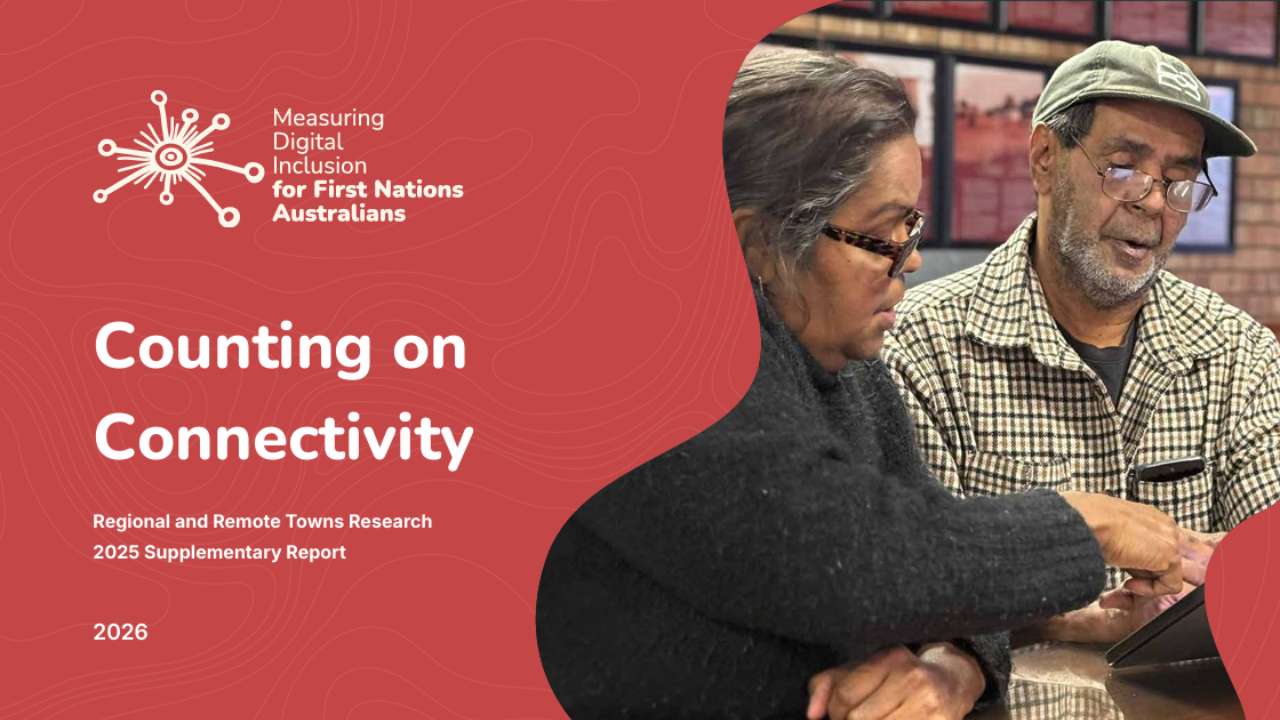
The Counting on Connectivity: Regional and Remote Towns Research 2025 Supplementary Report, released as part of the Measuring Digital Inclusion for First Nations Australians project, draws on 729 surveys conducted with First Nations people across ten regional and remote towns around Australia between June and September 2025.
The report found that while most participants regularly use digital technologies for essential activities such as banking, government services, communication, education and entertainment, many continue to face significant challenges related to connectivity, affordability and digital ability.
The report highlights that digital exclusion is shaped not only by infrastructure gaps, but also by broader social and economic inequalities.
Researchers found that many households in regional towns experience barriers similar to those faced in very remote communities, particularly where there is overcrowded housing, population mobility, limited infrastructure, and inadequate access to digital support services.
Marginalised groups including Elders, people with disability, language speakers, and those with limited formal education or employment opportunities.
“Without targeted programs to provide reliable and affordable household connectivity and support digital inclusion for these cohorts, there is risk of deepening localised digital divides and online harms,” the authors said.
Context matters
The research team said the findings demonstrate why “context matters” when designing digital inclusion policy.
“Every town is different. Some towns have high rates of mobility among First Nations residents similar to remote communities or homelands in the region, while others have a more stable population with greater education and employment opportunities,” said Associate Professor Daniel Featherstone.
An understanding of the contextual factors—geographic, demographic, economic and cultural—can help inform appropriate solutions to close the digital gap.
The researchers also emphasised the importance of Indigenous data sovereignty, with all participating communities receiving locally specific data to support community planning, advocacy and development.
Key findings:
- 65% of respondents did not have fixed home internet, compared with 10% of non-First Nations Australians
- 78% relied on prepaid mobile data plans
- 46% said they had cut back on essential expenses to afford internet access
- 27% used public Wi-Fi
- 58% accessed emergency information through face-to-face communication
- 26% had used generative AI tools in the past six months
The report calls for expanded policy attention for First Nations Australians living in regional and remote towns, and includes measures to:
- Address affordability through targeted and structural measures
- Strengthen community-based access infrastructure
- Improve household device access
- Invest in First Nations-led digital capability support
- Target infrastructure gaps within and around towns
- Expand First Nations media services
The research team thanks all partner organisations and the First Nations participants in the ten towns for ten generous participation and knowledge sharing.
The project forms part of the Australian Government-funded initiative measuring progress toward Closing the Gap Target 17, which aims to ensure Aboriginal and Torres Strait Islander people have equal levels of digital inclusion by 2026.
The supplementary report builds on the Counting on Connectivity report and dashboard launched in November 2025 and provides detailed community-level findings for each of the ten participating towns.
The project was funded by the Australian Government, with supplementary support from Telstra and the Australian Research Council via the ARC Centre of Excellence for Automated Decision-Making and Society (CE200100005).
The full report, downloadable datasets and regional site audits are available via the Australian Policy Observatory.
Read the latest report Regional and Remote Towns Research 2025 Supplementary Report
Read the Counting on Connectivity report released November 2025.