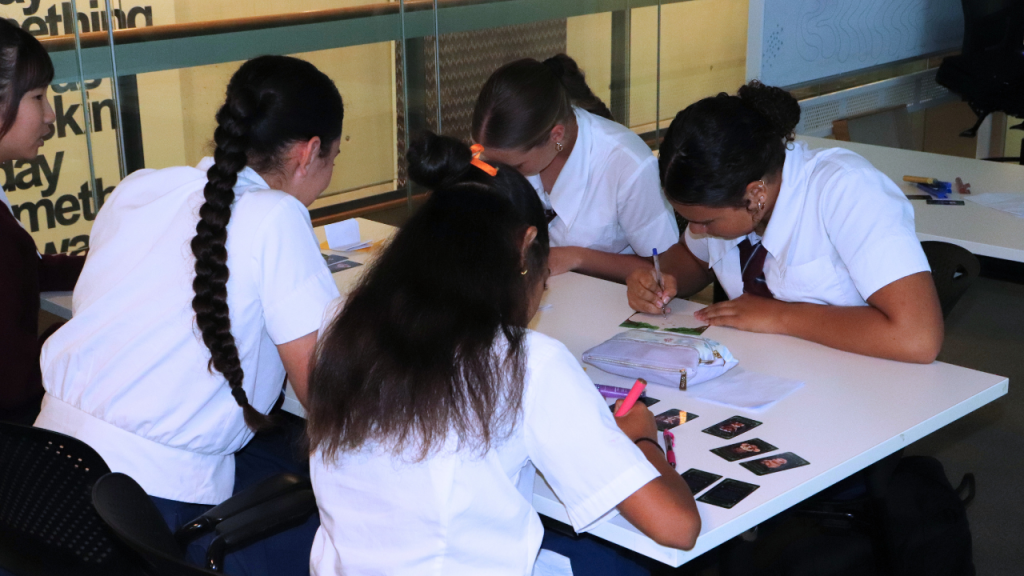
High school students explore AI, media literacy and digital futures at ADM+S
Author ADM+S Centre
Date 1 June 2026
Senior English students from Wavell Heights State High School recently visited QUT to explore topics of automation, and AI use in everyday life through an interactive session with researchers from the ARC Centre of Excellence for Automated Decision-Making and Society (ADM+S), QUT’s Digital Media Research Centre (DMRC) and the ARC Centre of Excellence for the Digital Child (Digital Child).
The visit introduced students to some of the key social, political and ethical questions surrounding emerging technologies and digital platforms, while also providing insight into how researchers investigate the impacts of AI and automation on everyday life.
“These experiences always reinforce to me that education remains one of the most powerful pathways to online safety and wellbeing,” said Professor Daniel Angus, Director of the DMRC and Chief Investigator from the ADM+S at QUT.
“Empowering young people with the knowledge and skills to critically navigate digital environments is likely to be far more effective than approaches that focus primarily on exclusion or restriction.”
Senior Research Fellow Dr Kim Osman from the DMRC and the ARC Centre of Excellence for the Digital Child led a session outlining two areas of research focus for QUT: digital inclusion and digital media literacy. The session provided students with an insight into the intersecting challenges that shape digital participation and the skills required to navigate an increasingly complex online information environment.
Students related digital media literacies back to the work they were doing in class and reflected on how digital inequity can affect how people develop digital media competencies.
Associate Professor Stephen Harrington from the Digital Media Research Centre introduced students to the concept of “Dark Political Communication” (DPC), an emerging form of political communication that can involve disinformation, inflammatory language and attempts to undermine trust in democratic institutions and the media.
The session examined how the attention economy is dramatically changing the types of communication that major political figures are using, and how the way that we determine ‘success’ in evaluating this messaging needs to be re-evaluated.
Students also took part in an interactive workshop led by Professor Daniel Angus exploring how digital platforms collect and categorise user data. Drawing on concepts from the “Data Mystics” public engagement project developed by ADM+S, DMRC and the Australian Internet Observatory (AIO), the activity encouraged students to reflect on how algorithms and advertising systems shape digital identities and online experiences.
Professor Angus noted, “it was wonderful to see how the students were already aware of the many ways in which their online activities leave data trails. The exercises we provided helped them to further reflect on and continue to develop their critical data literacy.”
The workshop introduced students to the work of the Australian Internet Observatory, a national research infrastructure initiative building tools and methods to support public-interest research into digital platforms, social media and emerging technologies.
Students also explored the GenAI Arcade from QUT’s GenAI Lab, an interactive resource designed to help the public better understand generative AI technologies through experimentation and play. The Arcade encourages users to critically examine both the capabilities and limitations of AI systems, while also considering broader issues such as environmental impacts, transparency and misinformation.
The visit offered students an opportunity to engage directly with researchers working at the forefront of AI, platforms and digital society research.