New report reveals how Automated Decision-Making is being reshaped across the Global South
Author ADM+S Centre
Date 7 September 2026
Research across six regions reveals how communities, businesses and governments are adapting and developing automated decision-making technologies in response to local needs.
A new report by researchers from the ARC Centre of Excellence for Automated Decision-Making and Society (ADM+S) challenges the dominant narrative that automated decision-making (ADM) is primarily developed in a small number of global technology hubs and then exported to the rest of the world.
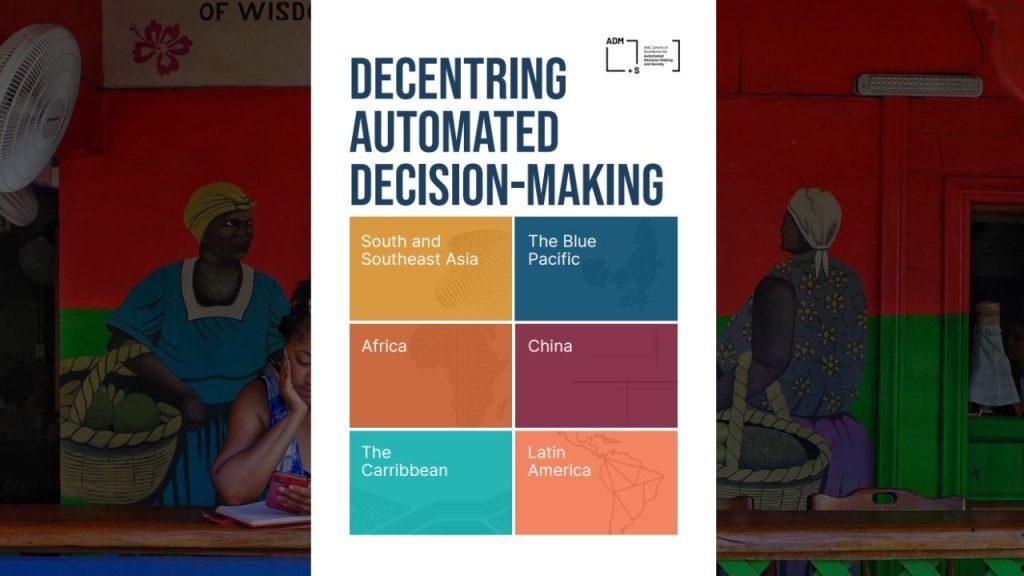
Edited by Professor Heather A. Horst (University of Sydney), Dr Adam Sargent (Australian National University) and luke gaspard (Western Sydney University), Decentring Automated Decision-making examines how technologies are being developed, adopted, adapted and contested across six regions: South and Southeast Asia, the Caribbean, the Blue Pacific, Africa, Latin America and China.
Rather than viewing the Global South simply as a source of labour, data or a site of technology adoption, the report shows how these regions are active sites of technological innovation, where automated systems are being shaped by local social, economic, political and environmental conditions.
The research also reveals that automation and AI does not look the same everywhere. Technologies range from sophisticated environmental data and agricultural systems to relatively simple chatbots, drones and digital platforms. In many cases, these systems are being developed not simply to replicate technologies from established technology hubs, but to address specific local challenges and opportunities.
“By exploring what ADM looks like across different regions and countries around the world, our aim is to challenge monolithic accounts of ADM and AI that feature in dominant discourses. Our decentred approach allows scholars and practitioners to reflect upon how ADM, AI and other technologies may be leveraged for better and alternative futures,.” said Professor Horst.
The report examines the global political economy underpinning these technologies, including the distribution of research and investment, digital labour, data infrastructures and emerging forms of value extraction.
It finds that the geography of ADM development remains highly uneven, with major technology companies concentrating investment in cities including Beijing, Shenzhen, Bengaluru, Hyderabad, Johannesburg, Nairobi and Accra. However, the reasons for these investments vary, ranging from access to skilled workers and new markets to manufacturing, infrastructure and socially focused initiatives.
The report also highlights the complex relationship between automation and human labour. Rather than simply replacing workers, many automated systems continue to depend on large amounts of human labour, much of it concentrated in the Global South and often poorly paid. At the same time, communities and workers are actively adapting these technologies to create new opportunities and livelihoods.
Innovation shaped by local contexts
The six regional case studies illustrate the diverse ways automated decision-making is being shaped around the world.
South and Southeast Asia: Indian climate-data company Blue Sky Analytics demonstrates how local technical expertise and relatively low-cost skilled labour can support globally competitive ADM infrastructures. The company transforms satellite and remote-sensing data into environmental datasets that can support applications such as air-quality monitoring and wildfire prediction. At the same time, restrictions on access to government satellite data demonstrate how regulation can constrain the development of data-driven technologies.
Blue Pacific: The Digital Tuvalu project explores how digital technologies could help preserve national identity, culture and governance in the face of climate change and potential displacement. By creating a digital representation of Tuvalu’s physical geography, cultural heritage and social institutions, the project raises new possibilities for maintaining aspects of national life in the context of climate mobility.
Africa: In Uganda, Flying Labs is using drones for disaster response, refugee settlement planning and agriculture. Drones have been deployed to map areas affected by landslides, identify evacuation and relocation routes and assess potential sites for infrastructure. The case also highlights the regulatory challenges that can emerge when technological innovation develops faster than policies governing its use and the data it produces.
China: In Guangzhou, digital technologies are being used to create a connected “field-to-table” agricultural system. The “Vegetable Basket” platform integrates e-commerce, logistics and product traceability, while technologies including AI, blockchain, big data and cloud computing support food-safety monitoring. Agricultural businesses are also using drones, automated systems and digital platforms to respond to labour shortages and improve supply chains.
Key findings:
- ADM innovation is geographically uneven but not confined to traditional tech hubs
- ADM development depends on global labour and data infrastructures
- Local regulation can enable or constrain innovation
- Communities in the Global South are adapting technologies to local needs
- Automation does not necessarily eliminate human labour
- ADM and AI can create both opportunities and new forms of inequality
The Caribbean: Fintech technologies, including non-fungible tokens (NFTs), are creating new opportunities for Caribbean artists to reach international markets and develop sustainable livelihoods. However, the research also reveals new forms of precarity, particularly through cryptocurrency volatility. Artist communities have responded by building networks of collaboration, knowledge-sharing and mutual support across national and linguistic boundaries.
Latin America: The Boti virtual assistant in Buenos Aires illustrates how relatively simple automated systems can be presented and adopted as AI. Operating through WhatsApp, Boti provides an accessible digital channel for public services, demonstrating how governments can use low-cost automation where more sophisticated AI infrastructure may be unavailable. The case highlights the gap that can exist between the rhetoric surrounding AI and the technical sophistication of the systems actually deployed.
Together, the case studies demonstrate that the impacts of automated decision-making are not determined by technology alone. They are shaped by local institutions, regulation, labour markets, social networks, economic conditions and community priorities.
The report also shows how global technology partnerships can produce unexpected outcomes. In Nigeria, for example, an AI education initiative intended to improve teaching evolved into a large-scale data collection project that contributed to the development of voice recognition systems for African languages.
The authors argue that understanding ADM through a “decentred” lens provides a more complete picture of how automated decision-making is developing globally. It moves beyond narratives that position the Global South primarily as a site of technological consumption, exploitation or data extraction, and instead recognises the agency and creativity of communities, businesses and governments developing and adapting these technologies.
The report provides comparative insights for researchers, policymakers and practitioners seeking to understand ADM beyond established centres of technological power. It also offers lessons for governments developing AI policy, highlighting the importance of considering local conditions rather than assuming that approaches developed in North America or Europe can simply be transferred elsewhere.
Ultimately, Decentring Automated Decision-Making argues that understanding the future of AI requires looking beyond traditional technology hubs and recognising the diverse ways automated decision-making is being developed, governed and reshaped around the world.
Chapter authors include: Edgar Gómez-Cruz (University of Texas), Heather A. Horst (University of Sydney), Liam Magee (University of Illinois), Sheba Mohammid (Western Sydney University), Brett Neilson (Western Sydney University), Ned Rossiter (Western Sydney University), Adam Sargent (Australian National University), Jolynna Sinanan (University of Manchester), Jason Titifanue (University of Melbourne), Yan Wang (Western Sydney University) and Yinghua Yu (Western Sydney University).
Read the full report Decentering Automated Decision-Making