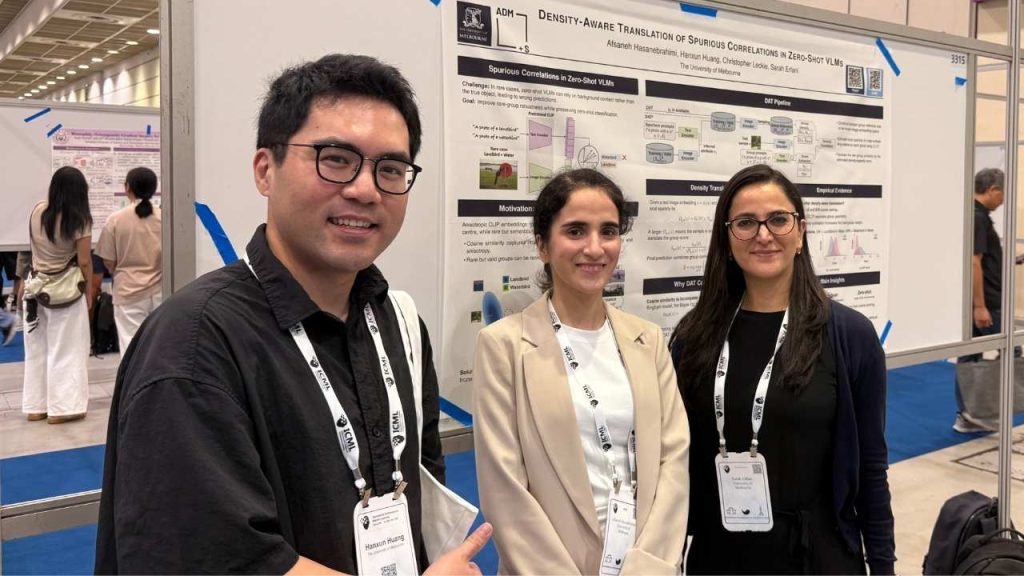
ADM+S researchers present at International Conference on Machine Learning
Author ADM+S
Date 7 August 2026
ADM+S researchers Dr Hanxun (Curtis) Huang, Afsaneh Hasanebrahimi, Hesam Asadollahzadeh and Professor Sarah Erfani from the University of Melbourne recently attended the 43rd International Conference on Machine Learning (ICML 2026), held in Seoul, South Korea.
The ICML conference brought together more than 13,000 attendees, providing ADM+S researchers with opportunities to share their work and engage with the international machine learning research community.
Dr Hanxun Huang presented the paper ‘AudioMosaic: Contrastive Masked Audio Representation Learning,’ developed as part of the Generative AI Test Range via the the Generative Authenticity project at the ADM+S Centre.
“Audio is increasingly important in applications, ranging from speech assistants and environmental monitoring to systems that detect synthetic or manipulated audio.” said Dr Hanxun Huang.
“However, training high-quality audio foundation models remains challenging, because labelled data is expensive to obtain.”
The paper introduces AudioMosaic, a self-supervised learning framework that trains an audio model using two complementary masked views of the same audio spectrogram.
The resulting representations provide a diverse range of solutions including audio classification, speech understanding, environmental sound, deepfake detection, and audio-language modelling. The paper demonstrates that AudioMosaic provides an efficient and effective approach for learning general-purpose audio representations.
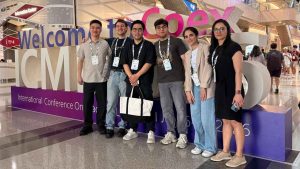
Afsaneh Hasanebrahimi presented the paper ‘Density-Aware Translation of Spurious Correlations in Zero-Shot Vision-Language Models’, which proposes a training-free method to reduce reliance on misleading contextual cues and improve model robustness in Vision Language-Models (VLMs).
“My main takeaway was the importance of looking beyond standard performance metrics and developing a deeper understanding of where, why, and for whom AI systems fail,” Afsaneh said.
“The conference also highlighted the need to examine less visible model behaviours, such as memorisation, spurious correlations, and over reliance on shortcuts, which may not be captured by conventional evaluation metrics,” she said.
At ICML 2026, the researchers also met with academics and industry researchers from organisations including ByteDance (US), OpenAI, Liquid AI and Dolby (US), creating opportunities for future collaboration in AI safety and agent evaluation. Hanxun said the conference reinforced the growing importance of simulation-based evaluation for AI agents.
“Many organisations are actively seeking robust methods to evaluate and assure the safety of AI agents before deployment, making our work both timely and practically relevant.” Hanxun said.