Feeling informed isn’t the same as knowing more: research examines climate change information across digital platforms
Author ADM+S Centre
Date 10 November 2026
From traditional news sources to platforms such as Instagram, TikTok and YouTube, people encounter information about climate change across an increasingly diverse media landscape. But how much of this exposure translates into actual knowledge? And does feeling informed necessarily mean we know more?
While social media platforms are increasingly important channels for science communication and public knowledge sharing, the algorithmic systems that influence which content becomes visible and reaches audiences remain largely hidden from public view.
Professor Cornelius Puschmann, Partner Investigator with the ARC Centre of Excellence for Automated Decision-Making and Society (ADM+S), has been investigating these questions through Informed by Influencers? (INDI), a research project at the University of Bremen examining news and climate information exposure. He recently presented findings from the project at a seminar hosted by ADM+S at QUT and QUT’s Digital Media Research Centre.
The four-month panel study combines mobile in-app tracking, automated content analysis and repeated surveys to investigate how people encounter and engage with news and climate information across digital platforms.
The project brings together three complementary analyses, examining how news exposure differs across dedicated news apps, Instagram, TikTok and YouTube; how frequently climate-related content appears in tracked TikTok feeds; and how using a wider range of media sources relates to climate interest, perceived informedness and factual knowledge.
“These audiovisual social media platforms share many common features, but at the same time the way in which they cater to users differs in relation to news and current information,” said Professor Puschmann.
“For YouTube we found a strong link between being politically interested and seeing news or political information on the platform, while for TikTok surprisingly enough a lack of interest in news was a predictor of news exposure through the app.”
“Finally on Instagram left-leaning users saw comparatively more content from political or news accounts than right-leaning ones.”
Tracking news exposure across digital platforms
The study revealed substantial differences in the reach, regularity and intensity of news exposure across different digital pathways.
Analysis of more than five million tracked TikTok video views found that climate-related terms appeared in only a small proportion of tracked views, highlighting the limited presence of climate-related content in the content people encounter on the platform.
Feeling informed isn't always the same as knowing more
An important finding from the research was the distinction between perceived and actual knowledge.
People who used a wider range of media sources tended to report greater interest in climate issues and higher levels of perceived informedness. However, this did not consistently translate into stronger factual knowledge about climate change.
The findings provide new insights into the relationship between everyday media use and public understanding, raising important questions about the kinds of information environments that support an informed public.
Challenges and opportunities for digital media research
The seminar also explored the opportunities and limitations of studying media exposure through digital traces. Professor Puschmann discussed challenges associated with incomplete tracking coverage, as well as the distinction between observed exposure and demonstrating learning.
Together, the project’s findings contribute to a growing body of research examining how algorithmically mediated platforms influence public knowledge and understanding of complex societal issues.
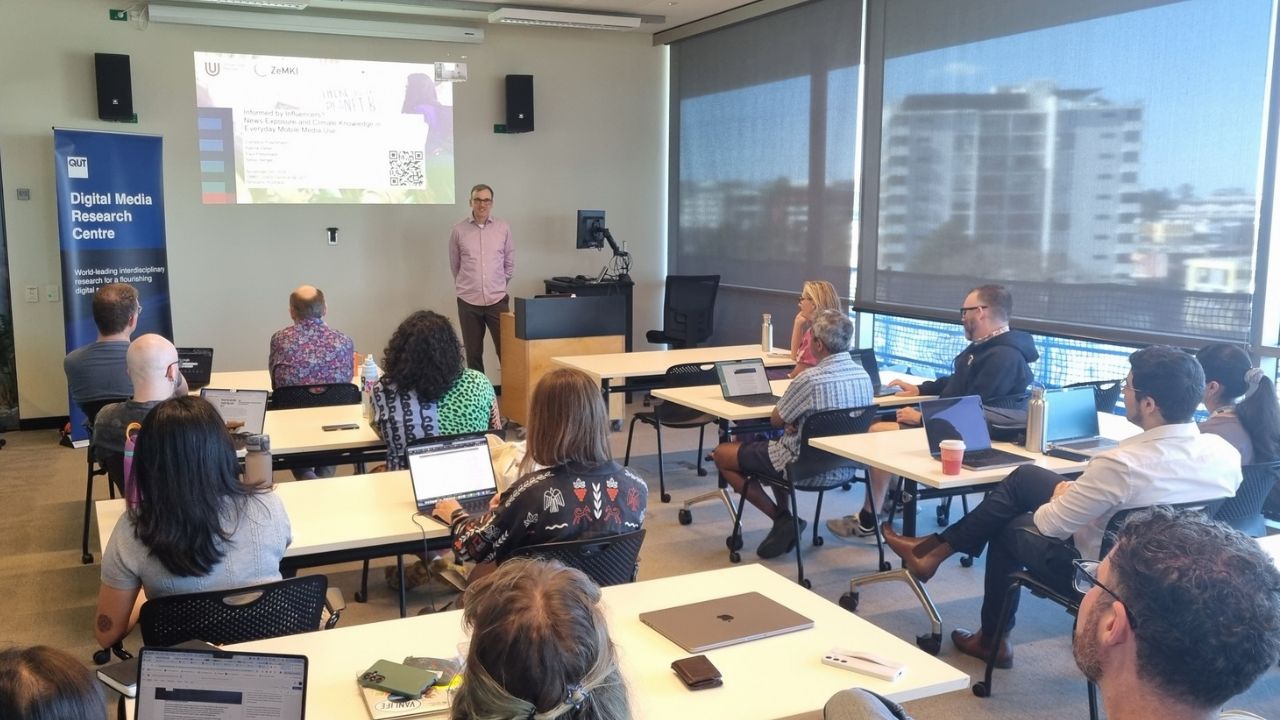
Professor Cornelius Puschmann is Professor of Communication and Media Studies with a focus on Digital Communication at ZeMKI, the Centre for Media, Communication and Information Sciences at the University of Bremen. He is also a Partner Investigator with ADM+S and has held visiting appointments at the University of Oxford’s Oxford Internet Institute, Harvard University’s Berkman Klein Center for Internet & Society, and the University of Amsterdam.
His research focuses on digital news use, online aggression, and the role of algorithms in the selection and visibility of media content.