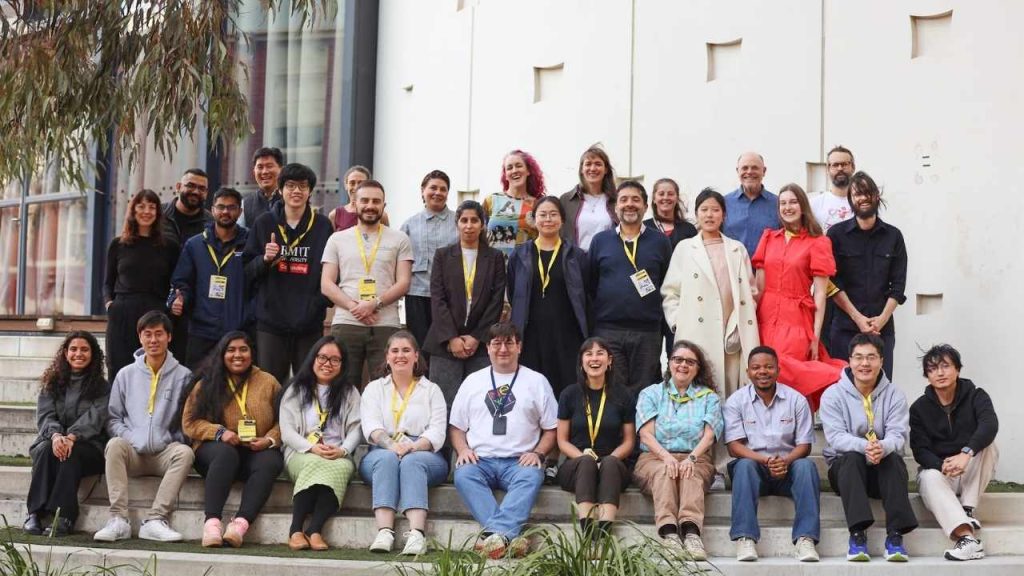
ADM+S Hackathon explores Death-Bots while rethinking AI Safety
Authors ADM+S Centre
Date 30 September 2026
As AI becomes increasingly capable of imitating people even after death, researchers at the ARC Centre of Excellence for Automated Decision-Making and Society (ADM+S) Hackathon considered what safety should look like in a world of digital replicas and death-bots.
Four teams took part in the Hackathon, bringing together researchers from ADM+S and the Swinburne Social Innovation Research Institute to explore the topic ‘The Post Imitation Game: Re-thinking the Turing Test for AI Safety.’
Organising committee lead and ADM+S Research Fellow Dr Dominique Carlon said they wanted teams to answer the question, what do we do now that AI can convincingly imitate people?
“Teams were challenged to develop a safety strategy that combined technical and design solutions, social interventions, and governance approaches to address the risks and opportunities of imitation technologies in specific real-world contexts,” she said.
From four potential scenarios, all Hackathon teams chose to explore one of the more complex and sensitive contexts for imitation technologies: the legacy and death-tech sector. Across the 3 days, teams assessed the safety considerations related to the use of a chatbot, or “death-bot,” that would represent a person after they had died. The real challenge lay in creating interventions that would allow people to use the death-bot in productive ways, such as grieving and remembering a person, while also avoiding unintended or negative consequences.
“Participants brought together expertise from both their disciplinary backgrounds and lived experience, to develop innovative and thoughtful responses to the complex challenges posed by AI-powered imitation technologies,” Dominique said.
Daniel Reeders, Senior Project Officer at National Organisation of People with HIV Australia (NAPWHA), an ADM+S collaborating organisation, said they were both surprised and impressed that all four teams chose a death-bot as their implementation of AI for the challenge. Daniel said it was exciting to see thoughtful conversations happening about the different regulatory perspectives that come into play.
“It’s been my pleasure at this Hackathon to be both a mentor and a judge,” Daniel said.
“That’s given me this incredible perspective on the really deep conversations that participants have been having at their tables about the thorny ethical, political, and technological issues that come up around death tech,” they said.
Amongst the four teams, there were a range of solutions proposed including regulatory frameworks and interventions addressing the critical ethical problems raised by this application of new technology.
The winning team, going by “Calico Cat team,” included Phoebe Matich, Ned Watt, James Marshall, Cindy Han, Yanheng Fang, and Jayme Verhagen. Participants from the winning team received recognition and feedback from the judging panel and $500 in research funding.
Throughout the Hackathon, mentors and team leads from across the Centre provided support in areas including
“We were incredibly impressed by the energy, creativity, and collaborative spirit they brought to the challenge,” Dominique said.
“We hope that the event serves as a catalyst for ongoing collaboration, research, and innovation across the universities in this area.”
ADM+S thanks the following ADM+S Hackathon judges: Daniel Reeders, (National Association of People with HIV Australia); Benjamin Kolaitis (Melbourne City Council); Christie Ditchburn (Telstra Sustainability, External Affairs and Legal Services); Professor Chris Leckie (University of Melbourne).