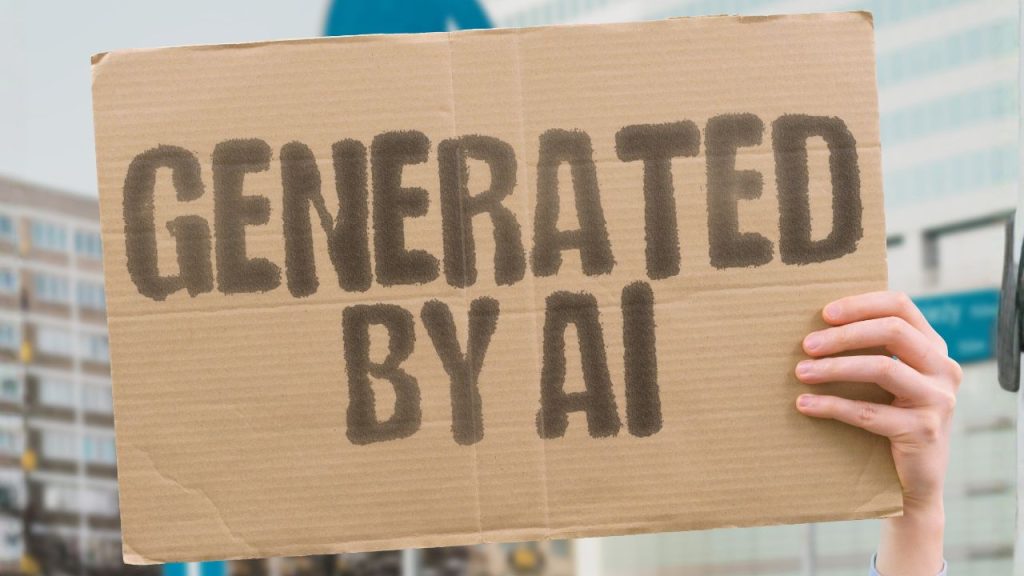
The Label Paradox: Can AI transparency create more distrust?
Author ADM+S Centre
Date 15 September 2026
As AI-generated content becomes increasingly difficult to distinguish from human-created material, AI labels are being positioned as an important tool for helping people understand what they are seeing and distinguish fact from fiction.
Under the European Union’s AI Act, new transparency requirements require certain AI-generated or manipulated content to be labelled.
But experts are questioning whether simply telling people that content was generated or modified using AI is enough and whether labels could make the problem worse.
“AI involvement is not in itself evidence that the claim is false, just as the absence of AI is not evidence that something is true,” said Tom Divon, Platforms and Activism Researcher at The Hebrew University of Jerusalem.
The issue was explored during a panel discussion, The Label Paradox: Can AI transparency create more distrust?, which brought together researchers and experts in AI regulation, media studies, psychology, language technologies and platform governance.
False binary between artificial and authentic content
Under the EU AI Act, transparency requirements cover areas including AI-generated or manipulated images, video and audio that could appear authentic, as well as certain AI-generated text intended to inform the public about matters of public interest.
The aim is to reduce risks such as deception, impersonation, misinformation and manipulation, while helping people better understand when AI has been used.
However, researchers warn that this could make people think content is either “AI-made and untrustworthy” or “human-made and trustworthy”, when the reality is much more complicated.
Professor Jean Burgess from the ARC Centre of Excellence for Automated Decision-Making & Society (ADM+S) at QUT, said authenticity was a much more complex cultural concept than simply determining whether AI had been involved in producing something.
“There’s no denying that there’s tremendous kind of anxiety and concern in the general population around the idea that they might be tricked,” Professor Burgess said.
Labels can help people stop and think about what they are seeing, she said, but they should not be treated as a “magic bullet”.
One concern is that people may interpret an AI label as a judgement about the content itself, rather than simply information about how it was produced.
Research has found that people can recognise that content is AI-generated but still fail to act on that information or simply scroll past it.
This raises the possibility of what researchers described as a “transparency paradox” – where a measure intended to increase informed engagement instead creates an automatic response of suspicion or rejection.
When AI is used to protect identity
The problem becomes particularly complicated when AI is being used for legitimate or protective purposes.
Activists, for example, may use generative AI to protect witnesses, translate testimony, remove identifying details or make sensitive material suitable for online platforms.
This could include altering a witness’s face or voice so they cannot be identified, while preserving the substance of their testimony.
But an “AI modified” label can strip away this context.
The label tells audiences that AI was involved, but not why it was used or what was actually changed.
As a result, information intended to improve transparency could instead become shorthand for “fake” or “don’t trust this”.
This is particularly significant at a time when people are already becoming more suspicious of images and videos they encounter online.
Who decides what is authentic?
The impact of AI labelling may also extend beyond what audiences think about content.
Platforms can use information about whether AI was used to create or modify content when deciding what people see online, including what gets recommended, promoted or flagged.
This means an AI signal could influence not only how an audience perceives content, but whether they see it in the first place.
Researchers warn this could disproportionately affect people whose content is already at risk of being misunderstood or marginalised.
It could also create problems for people who use AI for translation or accessibility, or for people communicating in languages other than English.
There are similar concerns for activists and human rights organisations working with sensitive material.
The text problem
The challenges become particularly complex when it comes to written communication.
AI tools can improve access to communication for people who are dyslexic, blind, speak minority languages or otherwise face barriers to producing conventional written text.
For example, someone might use AI to translate, edit or help structure something they have written.
But a label attached to the resulting text could cause readers to discount it simply because AI was involved.
This could undermine equal access to communication, particularly for people who have historically faced barriers to participating in public conversations.
Researchers stressed that there is an important difference between using AI as a translation or accessibility tool and using it to generate an entire piece of communication.
A simple “AI-generated” label may not capture that difference.
From labels to transparency infrastructure
Experts agree that labelling should be viewed as one component of a much broader transparency system rather than a solution in itself.
Professor Anja Bechmann, Professor of Media Studies and Director of DATALAB at Aarhus University, who chaired the European working group responsible for developing visible transparency labelling guidance, said the current approach is still evolving.
Testing of three different versions of icons in Romania and France found that the strongest-performing label increased awareness that content was AI-generated by 22 percent compared with an unlabeled control group.
The findings demonstrate both the value and the limitations of labelling.
“Labeling cannot stand alone,” said Professor Bechmann, arguing that a broader transparency infrastructure is needed, including organisational processes, technical standards, literacy initiatives and sector-specific approaches.
More information, not simply more labels
The challenge now is to move beyond the question of whether content is AI-generated and ask what information people actually need to make informed decisions.
Rather than simply stating that content was AI-modified, a label could explain whether AI was used for translation, voice alteration, image editing, anonymisation or another specific purpose.
Researchers stress the importance of distinguishing disclosure from verification.
Knowing that AI was involved does not establish whether something is true or false. Likewise, knowing that AI was not involved does not make a claim inherently trustworthy.
“The presence of AI is a shortcut for distrust,” said Tom Divon, arguing that more precise disclosure could help prevent AI involvement from becoming an automatic signal that something should be rejected.
Building trust without creating suspicion
The goal should not simply be to tell people that AI was involved. It should be to give people enough meaningful information to assess content for themselves.
That means developing better technical tools, improving AI literacy, understanding how labels influence behaviour, and creating sector-specific standards for responsible AI use.
It also means recognising that misinformation, propaganda and harmful content existed long before generative AI.
The challenge is therefore not simply determining whether something is artificial.It is developing the knowledge, infrastructure and social systems that allow people to understand what they are seeing, why it was created, what has been changed and whether they should trust it.
The discussion brought together experts from AI regulation, media studies, cognitive psychology, computational linguistics and platform governance:
- Professor Jean Burgess, Distinguished Professor of Digital Media at QUT and Associate Director of the ARC Centre of Excellence for Automated Decision-Making and Society (ADM+S)
- Professor Anja Bechmann, Professor of Media Studies and Director of DATALAB at Aarhus University
- Professor Anders Søgaard, Professor in Natural Language Processing and Machine Learning at the University of Copenhagen
- Tom Divon, Platforms and Activism Researcher at The Hebrew University of Jerusalem
- Dr Laurens Naudts, Researcher at the Institute for Information Law, University of Amsterdam and AI, Media & Democracy Lab
The panel was moderated by Professor Natali Helberger, Distinguished University Professor of Law & Digital Technology at the University of Amsterdam and co-director of the AI, Media & Democracy Lab.
View the full panel discussion The Label Paradox: Can AI transparency create more distrust?