THE CONTEXT
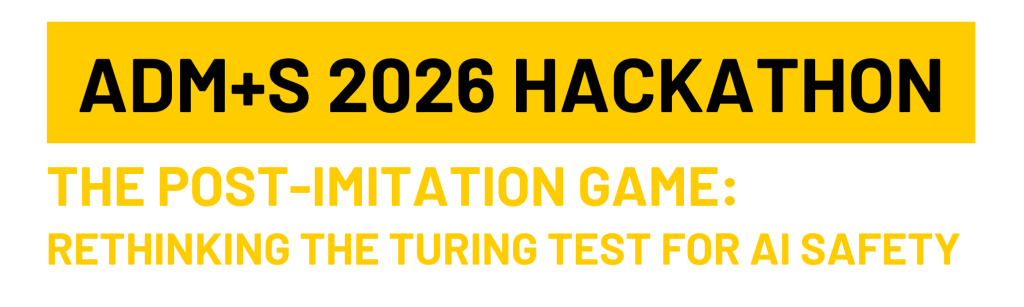
The Post-Imitation Game
In 1950, Alan Turing proposed the Imitation Game, asking whether a machine could communicate in such a way that a human judge could no longer distinguish it from a person. Turing was not trying to prove that machines are intelligent or capable of thought. Instead, he offered a testable provocation: a human judge would exchange text with two hidden judges (one human, one machine) and if the judge could not reliably tell them apart, the machine was said to have passed the game.
Turing’s proposal did more than evaluate the capability of machines; it also exposed how humans attribute intelligence, how we are persuaded by cues, and how our judgements are shaped by context and expectation. Although Turing was explicit that the Imitation Game was never meant to be an end goal, it set in motion decades of AI research focused on producing systems aiming to imitate human likeness.
Seventy six years on, publicly available AI systems can now imitate not only written communication, but also the visual and aural traits of individuals (including voice, gestures, phrasing, facial expressions, and subtle mannerisms). Through “deepfakes”, voice synthesis, large language models, and other forms of synthetic media, the replication of a person’s likeness has become widespread, circulating online both with and without the ‘versioned’ person’s consent or awareness. Behind every imitative version is a real person who exists, or once existed, in real space and time. Imitation technology therefore has complex real world consequences and is not monolithic; its impacts depend on context, conditions, consent, and public awareness.
Today, the question is no longer whether AI can imitate humans, but what should we do now that they already do? Generative AI systems routinely produce text, audio, images, and video that convincingly imitate human communication, and the likeness of specific individuals through ‘deepfakes’, voice clones, and other forms of synthetic media. This is not always harmful; the consequences depend on the context and conditions where used.
THE CHALLENGE
The 2026 Hackathon
The ADM+S/Social Innovation Research Institute Hackathon responds to this new reality, asking what follows from the “success” of the Imitation Game – and what a great mind like Turing might have done now that imitation has been achieved.
Over 2.5 days, teams of researchers from different disciplinary backgrounds will select and analyse real‑life scenarios where AI has been used to impersonate specific individual (from the pack provided on the day). From these scenarios, they will reverse‑engineer what went wrong and identify meaningful intervention points, designing coordinated safety strategies that combine technical, community, and governance responses. The teams will then present their proposals to a panel of industry and academic judges, who will evaluate how inclusive, practical, and grounded in real‑world conditions the responses are in addressing technologies that imitate people.
WHAT TO EXPECT
Day 1 (3pm-5pm)
Meet your team over refreshments at Swinburne’s Virtual Universe. After your tour of the known universe, you’ll hear from guest speakers about Alan Turing’s time at Bletchley Park, the realities of identity and authentication verification for online communities, and how AI — and humans — are reshaping the nature of scams. Teams will then join in some friendly competition with a voice‑detection quiz, with points and prizes up for grabs. Afterwards, you can meet the guest speakers and get to know your team better at the Hawthorn Hotel (meal vouchers provided).
Day 2 (9.30am-4.30pm)
Your team will select one case from the Scenario Pack (provided on the day) involving technologies used to imitate specific individuals. These are real‑world incidents, and choosing one provides the concrete setting from which you will analyse how the incident unfolded — including the technical factors, social and interpersonal dynamics, and institutional or governance conditions that allowed the harm to occur. You will then consider what types of interventions could have led to a safer outcome.
Designing your safety strategy:
Working together, your team will develop a coordinated safety strategy that includes interventions across the following layers:
Technical/design: How technology, testing, or design contribute to safety in (or respond to) technologies that imitate human likeness. Examples include interface design, testing processes, guardrails, transparency cues, verification or authentication mechanisms, and other design‑level interventions.
Community: Ways to support people and communities to navigate imitation technologies safely. Examples include awareness and public education initiatives, community‑led or inclusive participation processes, and accessible literacy resources.
Governance: Policies, rules, standards, institutional practices, or reporting mechanisms needed to shape safe use of or responses to imitation technologies. Examples include information sharing, organisational standards, oversight processes, and pathways for reporting and redress.
Note: An AI safety strategy, in this context, is a coordinated plan that sets goals, priorities, and aligns actions and resources to achieve outcomes. Strategies bring together multiple moving parts (ie interventions, responses, and capabilities) that must be coordinated to work together. Single‑layer approaches routinely fail. For instance, technical fixes can be bypassed or become outdated; community awareness alone shifts unreasonable burden onto individuals and can widens inequalities; and governance responses are often slow, reactive, or arrive only after harm has occurred. Your strategy will be assessed on how well the layers support and complement each other.
Mentor guidance and panel discussion
Throughout the day, you will receive guidance from mentors, including a panel discussion on the state of AI impersonation technologies and key considerations for developing feasible technical, community, and governance safeguards.
Panellists:
- Jean Burgess (ADM+S and QUT)
- Daniel Reeders (NAPWHA)
- Awais Hameed Khan (RF ADM+S, UQ node)
- Zafaryab Rasool (RF ADM+S, Swinburne node)
- Moderator: Dominique Carlon
Day 3 (9.30am – 4pm)
On Day 3, your team will work on preparing and presenting your proposed safety strategy to a panel of industry and academic judges. Each team has 8 minutes.
Your presentation must:
- Refer to the scenario you selected
- Provide a brief overview of your reverse‑engineering analysis and the intervention points you identified
- Focus on your layered safety strategy and explain how your proposed technical, community, and governance interventions work together
- Respond to the provocation: What would Turing do today?
You have full creative freedom on how your team presents the work: make a video, show your process, present your working notes, perform a live demonstration, pre‑record elements, or innovate in any format your team agrees on.
RESOURCES
The Imitation Game
A. M. Turing (1950) Computing Machinery and Intelligence. Mind 49: 433-460
https://courses.cs.umbc.edu/471/papers/turing.pdfring.pdf
Oscar Schwartz (2019) Untold History of AI: Why Alan Turing Wanted AI Agents to Make Mistakes Infallibility isn’t the same thing as Intelligence https://spectrum.ieee.org/untold-history-of-ai-why-alan-turing-wanted-ai-to-make-mistakes
AI Impersonation
Tactical Tech (2024) “The Virtual Big Bad Wolf: Be wary of AI-powered Scams”
https://datadetoxkit.org/en/ai/tricks/x Kit
Safa Ghnaim, Liz Carrigan, Louise Hisayasu, Dominika Knoblochová, Dominique Carlon, Awais Hameed Khan, Anthony McCosker (2025) “Whose Voice Is It Anyway: Navigating the Highs and Lows of Voice AI” https://datadetoxkit.org/en/ai/voice
Leah Henrickson and Dominique Carlon (2024) “An influencer’s AI clone started offering fans ‘mind‑blowing sexual experiences’ without her knowledge” The Conversation https://theconversation.com/an-influencers-ai-clone-started-offering-fans-mind-blowing-sexual-experiences-without-her-knowledge-232478 influencer’s AI clone started offering fans ‘mind-blowing sexual experiences’ without her knowledge
Preeti Kulkarni, Hyberverge (June 8 2026) https://hyperverge.co/blog/examples-of-deepfakes/les That Shocked the World
The Turing Triage Test
Robert Sparrow
https://drive.google.com/file/d/15uOLWpjV1QxWurUP2r-J7hk5pA126q-y/view?usp=drive_link
JUDGING CRITERIA
The judging panel includes:
- Benjamin Kolaitis, Partnerships and Programs Coordinator, Melbourne City Council;
- Prof Chris Leckie, Chief Investigator ADM+S, University of Melbourne
- Christy Ditchburn, Sustainability Principal, Telstra Sustainability, External Affairs and Legal Services team
- A mystery judge!
The challenge will be assessed according to the following criteria:
- Intervention points: Are they meaningful, realistic, and grounded in the scenario?
- Strategy coherence: Do the technical, community, and governance interventions reinforce each other?
- Multi‑disciplinary thinking: Does the strategy draw on diverse perspectives and expertise?
- Human‑centred and accessible: Are the proposed safety benefits accessible to people with different levels of literacy, support, and familiarity with technology and AI?
- Feasibility and clarity: Is the safety strategy practical, implementable, and clearly articulated?
- Teamwork and originality: Creativity, inclusiveness, and collaborative spirit.