8.30am
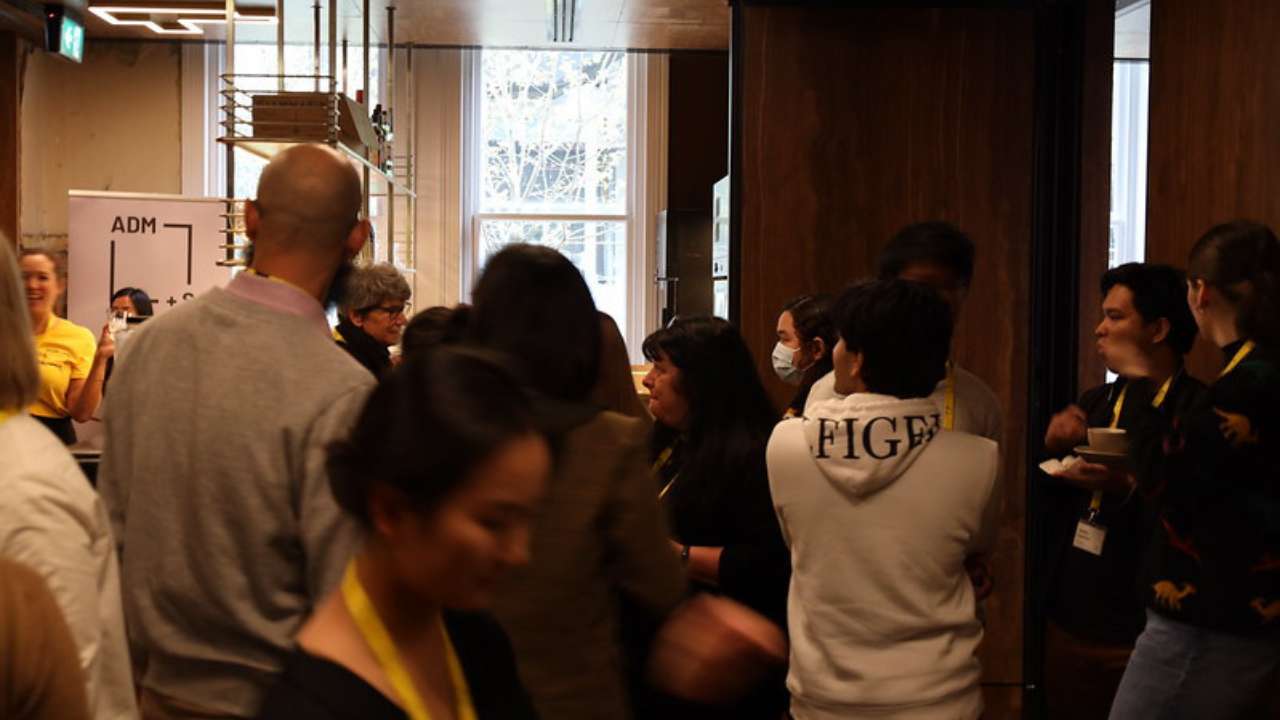
Pre-Summer School Coffee Meet-Up
Seminar Rooms 1 & 2
Read More:
Description: This informal Pre-Summer School Coffee Meet-Up aims to provide HDR students with a welcoming, low-pressure environment to connect and engage before the formal program begins. Scheduled for the morning of the first day, before the official summer School welcome session, the meet-up offers students an opportunity to meet peers, share experiences, and feel part of the broader ADM+S HDR community.
Proposed outcomes for participants:
- Foster early social connections among HDR students
- Encourage wellbeing by promoting a relaxed and supportive start to the Summer School
- Introduce a new practice of regular, informal HDR coffee mornings
- Provide a space for students to raise ideas, issues or suggestions for the HDR Committee in an accessible and collegial setting. Ultimately, this initiative aligns with the HDR Committee’s 2026 goal which is to strengthen community, inclusion, and wellbeing among HDR students within ADM+S.
9.00am
Morning Tea
ROOM 1 (HYBRID)
ROOM 2
9.30am
SESSION 07 (HYBRID)
Who Does (and doesn’t) Get to Participate in Our Research? Developing Inclusive Research Methodologies
Presenters: Kieran Hegarty, Jenny Kennedy, Justine Humphry, Charishma Ratnam
Read More:
Description: Many research projects depend on engaging a “sample” that is assumed to represent a wider group. But the way we design our methods can quietly exclude people from taking part. For example, relying on online interviews or digital methods assumes that participants have access to specific platforms (like Zoom or Teams), suitable devices, enough data, and a stable connection. These assumptions can exclude people who are more likely to experience digital exclusion, including those on low incomes, older people, and people in regional and remote areas.
This workshop invites participants to look at their research design through a digital inclusion lens. When we use online tools for data collection – from surveys and videoconferencing to “digital walkthroughs” and “scroll backs” – what are we assuming about people’s access, resources, and skills? What happens when these assumptions are wrong and methods fail, when participants can’t access a platform or misunderstand what they are being asked to do? And how can these moments become opportunities for methodological reflection and innovation rather than just problems to be worked around?
The session will focus on practical strategies for designing more inclusive research, and on recognising who may be missing from our projects and why.
SESSION 08
Generative AI and the reshaping of scholarly communication, authorship, and the academic publishing process.
Presenters: Kevin Witzenberger, Peta Mitchell, Jean Burgess, Cesar Ariza Rojas, Michelle Riedlinger
Read More:
Description: This hands-on workshop is an extension of our current ARC Discovery project Generative AI and the Future of Academic Publishing, which investigates the technologies, practices, and norms emerging at the intersection of generative AI and academic research, and the role they are playing in the transformation of the scholarly economy.
In this session, we will provide a brief overview of the project and its findings to date. We will then guide attendees through a systematic critical evaluation of prominent Research GenAI (RGAI) tools, based on the extended app walkthrough method (Light, Burgess & Duguay, 2016).
By collaboratively mapping use cases to a normative matrix, we will then explore and test consensus on the norms for a range of scholarly uses and non-uses of generative AI in academic research, paying particular attention to disciplinary and institutional differences.
Proposed learning outcomes for participants:
By the end of the session, participants will be able to critically evaluate Generative AI tools for their use in research discovery and scholarly writing and a deeper understanding of the role of generative AI technologies in reshaping scholarly communication, authorship, and the academic publishing process.
10.45am
SESSION 09 (HYBRID)
Verifiable User Simulation for Search and Recommendation Systems
Presenters: Chenglong Ma, Xinye Wanyan, Nuha Abu Onq
Read More:
Description: This session introduces verifiable user simulation as a rigorous method for evaluating search and recommendation systems. Participants will explore how Large Language Models can emulate user behaviour, and how such simulations should be validated against real interaction data to ensure behavioural realism and fairness.
We will use an interactive web demonstrator that allows participants to adopt simulated personas, issue queries, and observe how user profiles affect retrieval and RAG outcomes. Through mini-exercises and group discussions, participants will design and critique verification protocols and gain practical insight into trustworthy simulation design.
Proposed learning outcomes for participants:
By the end of the session, participants will be able to
- Understand opportunities and risks of LLM-based user simulation
- Learn simple verification and fairness-checking methods
- Gain hands-on experience with persona-based evaluation tools
SESSION 10
From Burnout to Balance: Practical Steps for Neurodivergent Professionals
Presenter: Ani Møller
Read More:
Description: In this interactive session, you’ll discover practical strategies for assessing, preventing and recovering from burnout as a neurodivergent professional. A burnout risk assessment will be provided, you’ll identify where you currently stand and receive recommendations based on your results. Leave with a clear understanding of your unique warning signs and actionable tools tailored to your specific needs that you can implement immediately.
12.00pm
Lunch and Mentoring
12.00pm
Head Shots
Does your profile photo need a refresh?
Stop by the ADM+S photo booth and update your head shot.
1.00pm
SESSION 11 (HYBRID)
The Art of the Abstract: Clarity in 250 Words in to industry
Presenter: Dan Angus
Read More:
Description: In this session, we’ll make the abstract concrete. Drawing on John Swales’ classic framework for academic writing, participants will learn how to craft abstracts that are clear, compelling, and purposeful. Collectively we will unpack what makes a strong abstract, one that not only captures attention but also crystallises the core of your research. Along the way, we’ll explore how the process of writing an abstract can sharpen your thinking, refine your focus, and even shape the direction of your work.
Proposed learning outcomes for participants:
By the end of the session, participants will:
- Identify the key rhetorical moves that underpin effective academic abstracts.
- Evaluate the strengths and weaknesses of existing abstracts across disciplines.
- Apply Swales’ framework to produce a concise, coherent, and persuasive abstract.
- Use abstract writing as a tool for refining research focus and articulating contributions.”
SESSION 12
Hands-on Tutorial: Build Your Own Retrieval-Augmented Generation (RAG) System
Presenters: Futoon Abushaqra, Sachin Pathiyan Cherumanal
Read More:
Requirements: Attendees must have access to a Google account.
Description: This session will introduce participants to the fundamentals of RAG, a powerful framework that combines information retrieval with large language models (LLMs) to generate more context-aware responses. Through a guided, hands-on tutorial, participants will learn how to connect an LLM to their own data sources and build a simple RAG-based question-answering system.
Proposed learning outcomes for participants:
By the end of the session, participants will:
- Be able understand the core architecture of a RAG system
- Build and run a simple prototype
- Learn practical tips for improving retrieval quality and reducing hallucinations”
2.15pm
Afternoon Tea
2.45pm
SESSION 13
Decoding Job Apps
Presenters: Fan Yang, Kieran Hegarty
Panel members: Christine Parker, James Meese, and Danula Hettiachchi
Read More:
Description: In this panel workshop, ADM+S students and early-career researchers will hear from academic colleagues about what is expected in job applications, how applications are evaluated, and how to craft our academic narratives to specific job descriptions. The session will also explore how to craft, communicate, and highlight your academic stories. We hope that you will walk out of the session feeling energised, refreshed, and more confident, with a clearer sense of what you have achieved in the past and the direction for where you want to go next!
Proposed learning outcomes for participants:
By the end of the session, participants will:
- Understand the key components of an academic job application and how selection committees typically evaluate them
- Identify common pitfalls in academic job applications
- Identify strategies to tailor their academic narrative to specific jobs
- Succinctly articulate their core areas of expertise and achievements
SESSION 14
Approaching AI Governance: Ideas From Policy Studies
Presenter: Kimberlee Weatherall, Alexandra Sinclair, Yunus Yigit
Read More:
Description: AI has generated considerable debates about if and how it is to be governed in order to ensure its use is safe, fair and responsible. Typical approaches focus on ethical principles translated into legal responses. However, there is a wide range of approaches to governance both in legal extra-legal design. This session will engage participants in different types of AI governance, ranging from laws and regulations, to principles, and guidelines and guardrails. It will introduce participants to the tools of government model, the forms of governance taxonomy, and modes of regulation, thereby highlighting the myriad ways AI can be governed. These approaches will be drawn from the public policy, public administration, regulatory studies and legal design literatures. Workshop participants interactively explore an AI policy problem with the different tools.
Proposed learning outcomes for participants:
After completion of this workshop, participants will be able to:
- Understand and critically assess different governance approaches, strategies and tools for AI governance
- Utilise the Tools of Government approach in different AI use scenarios as a way to generate multiple governance responses
- Make connections between high level policy to real-world AI use cases.
4.15pm
She Shapes History: Badass Women of Melbourne
Meeting Point: Outside Queen Victoria Women’s Centre, 210 Lonsdale Street Melbourne, VIC
Read More:
Important: Spots are limited. Sign up at the registration desk in the Green Brain Conference Rooms Foyer.
This is the story of Melbourne – told by the women who shaped it. Hidden amongst Flinders Street Station, Federation Square, the State Library, the Princess Theatre and Parliament House are the stories of women who shaped Melbourne.
Walk through the heart of the city where women built hospitals, launched movements, soundtracked our streets, and transformed culture – often without recognition. From the steps of Parliament to tucked-away laneways, you’ll meet artists, agitators, entrepreneurs and everyday rebels who dared to speak up and shape the city around them.
Come ready to see Melbourne differently – and to carry these stories with you long after the walk ends. This tour will leave you feeling inspired, grounded, and ready to shape history yourself.
Please wear comfortable walking shoes.