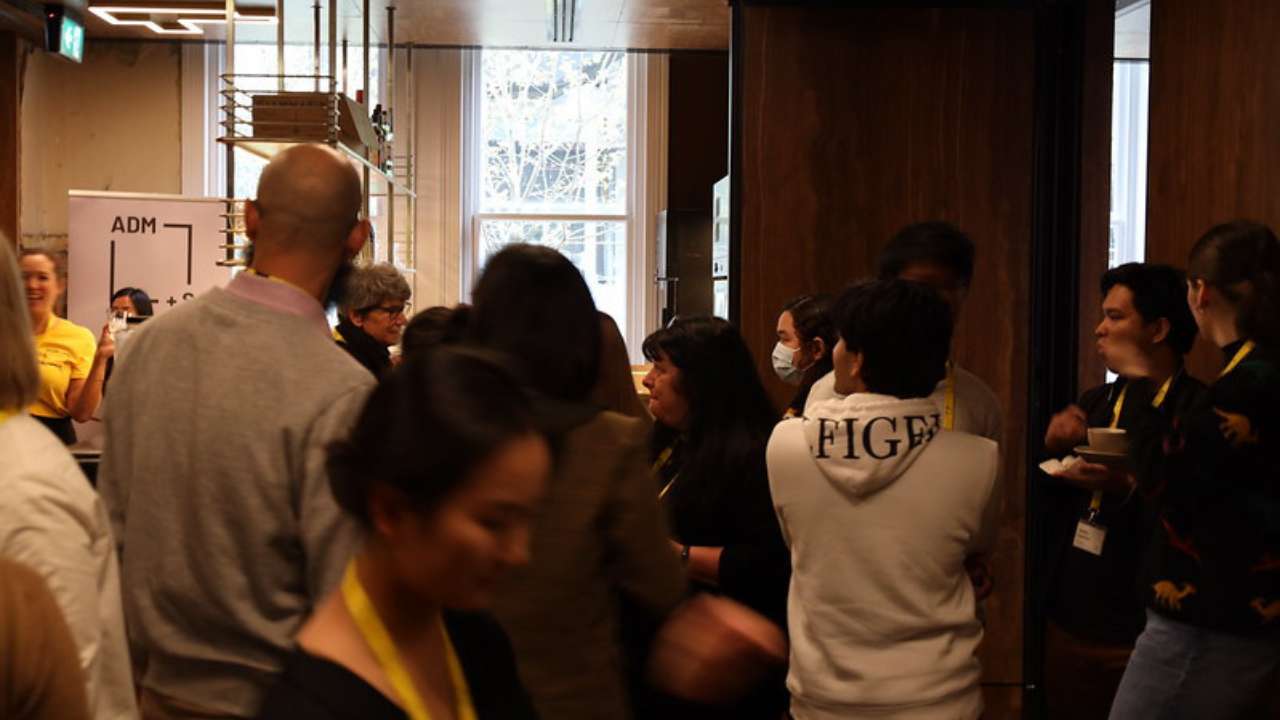
8.30am
Pre-Summer School Coffee Meet-Up
Seminar Rooms 1 & 2
Read More:
Description: This informal Pre-Summer School Coffee Meet-Up aims to provide HDR students with a welcoming, low-pressure environment to connect and engage before the formal program begins. Scheduled for the morning of the first day, before the official summer School welcome session, the meet-up offers students an opportunity to meet peers, share experiences, and feel part of the broader ADM+S HDR community.
Proposed outcomes for participants:
- Foster early social connections among HDR students
- Encourage wellbeing by promoting a relaxed and supportive start to the Summer School
- Introduce a new practice of regular, informal HDR coffee mornings
- Provide a space for students to raise ideas, issues or suggestions for the HDR Committee in an accessible and collegial setting. Ultimately, this initiative aligns with the HDR Committee’s 2026 goal which is to strengthen community, inclusion, and wellbeing among HDR students within ADM+S.
9.00am
Morning Tea
ROOM 1 (HYBRID)
ROOM 2
9.30am
SESSION 15 (HYBRID)
Media Technologies, Methodologies and Research Skills – A Reflection On Complex Interdisciplinary Research Projects
Presenters: Ashwin Nagappa, Kateryna Kasianenko, Elif Doyuran, Phoebe Matich, Khanh Luong
Read More:
Description: This session will start with a brief panel discussion focusing on the changes in media technologies, particularly digital media, exploring the evolution of research methodologies alongside technological changes and discussing how researchers adapt and acquire new skills in response. As interdisciplinary work increases, we must be versatile and able to quickly adapt to change.
Following the panel discussion, there will be hands-on workshops where participants will map past, present, and future changes in digital media, along with the corresponding shifts in research methods and the critical skills needed for these changes. Participants will use these reflections to project future possibilities and design their upcoming projects accordingly.
Furthermore, we will locate digital media methods within the broader context of research design and reflect on how these methods connect to research questions, theory, and practice. Are the questions we are trying to answer evolving alongside new methodologies? What constitutes an effective pairing of question and method? These discussions will enhance our understanding of how methodological innovations can reshape our inquiries, leading to richer, more nuanced insights in the field of digital media.
Proposed learning outcomes for participants:
Participants will engage in exercises designed to refine their question-method pairs and explore the implications of methodological choices for research outcomes, thereby fostering a deeper connection between theoretical frameworks and practical research applications.
SESSION 16
Free Session
Presenters: N/A
Read More:
Description: Please take this opportunity to socialise, get some fresh air and rehydrate as needed.
10.45am
SESSION 17 (HYBRID)
Managing the Research Data Lifecycle: From Creation to Curation
Presenter: Dan Angus
Read More:
Description: Good research data management (RDM) practices don’t just happen at the end of a project, they start from the very beginning. This interactive workshop will walk participants through the full data lifecycle, before, during, and after research. We will highlighting practical approaches and common challenges at each stage. Together, we’ll unpack topics such as data storage and backup strategies, ownership and control, the realities of ‘messy data’, and the trade-offs between using databases and local copies. We’ll also explore how to prepare data for sharing and publication, including when and how to mint DOIs, and what it means to make data genuinely FAIR (Findable, Accessible, Interoperable, and Reusable).
Participants are encouraged to share their own experiences and challenges as we discuss how to navigate institutional, ethical, and technical constraints.
Proposed learning outcomes for participants:
By the end of the session, participants will come away with a clearer understanding of how to design a data management strategy that supports better, more transparent, and more impactful research.
SESSION 18
Introducing the New Sociotechnical-Detection Practices for Online Verification
Presenters: Devi Mallal, Ned Watt, Silvia Montana-Nino, Michael Richardson, Michelle Riedlinger
Read More:
Description: This hands-on workshop builds on our ongoing ADM+S fact-checking research collaboration and work in the Generative Authenticity project to understand changes in content detection and verification practices in the digital news ecosystem. The team will take participants through an industry-standard content verification workflow and share findings from projects investigating the new authenticity infrastructures available to journalists and fact checkers. It will introduce attendees to the growing suite of technical and non-technical strategies for authenticating content.
Through collaborative analysis and discussion, we will explore how an epistemic technological reorientation may be underway in professional content verification, involving new socio-technical approaches, AI detection tools, and traditional judgments.
Participants will engage in discussion around the tools and techniques they use in the workshop and how they compare to emerging benchmarks, standards, cultures, and practices of AI verification, including debates about accessibility, explainability, and effectiveness of verification tools, and how they fit within the larger verification and authentication ecosystems.
Proposed learning outcomes for participants:
By the end of the session, participants will have practical experience and a deeper understanding of how to critically engage with content verification and the combination of socio-technical skills required to determine the authenticity of content.
12.00pm
Lunch and Mentoring
1.00pm
SESSION 19 (HYBRID)
Gems in the Slop: Critical-Creative AI for Fun & Profit
Presenter: Daniel Binns
Read More:
Description: What happens when generative AI tools misfire, misunderstand, or hallucinate? This hands-on workshop explores critical-creative approaches to working with (and against) GenAI systems. Drawing from media research, design methods, and glitch aesthetics, we’ll treat AI not just as a tool, but as a messy collaborator. Through demos, prompt experiments, and interpretive exercises, participants will learn to extract insight from error, build weird workflows, and document their own slop-inflected research processes.
Proposed learning outcomes for participants:
Come curious and leave with new techniques, frameworks, and possibly a glitched assistant of your own!
SESSION 20
Behind the Feed: A Simulated News Ranking experience
Presenters: James Meese, Joanne Kuai, Kyle Herbertson
Read More:
Resource: Behind The Feed
Requirement: Attendees must have access to the ‘GenAI arcade’ website (https://behind-the-feed.vercel.app/)
Description: This session introduces participants to a custom-designed card game that simulates how news recommendation systems operate in practice. We invite participants to step into different roles, and make decisions that affect how news is ranked, surfaced, and consumed.
Through gameplay, participants will experience the mechanics, trade-offs, and tensions inherent in personalised news environments. The aim is to offer an accessible, hands-on way to explore complex issues such as algorithmic bias, diversity in news exposure, value conflicts, platform incentives, regulatory solutions, and the democratic implications of recommendation technologies. A facilitated debrief will link the game dynamics to current academic debates and empirical challenges in auditing and governing recommender systems.
Proposed learning outcomes for participants:
By the end of the session, participants will:
- Develop a practical and intuitive understanding of how news recommendation algorithms shape information exposure
- Recognise the competing priorities and constraints influencing platforms, news organisations, and users
- Identify key risks of algorithmic recommendation, including bias, opacity, personalisation traps, and reduced news diversity
- Reflect on possible governance approaches and interventions illuminated through the game scenarios
2.15pm
Afternoon Tea
2.45pm
SESSION 21
Using collage to visualise the language of GenAI
Presenter: Deborah Lupton
Read More:
Resource: Visualising Generative AI with Collage
Description: Participants will learn about how to use the arts-based technique of collaging to visualise the language of GenAI as a mode of social critique of these technologies. They will learn how digital tools such as Canva and online public domain image repositories can be used for this purpose.
SESSION 22
Introduction to Python for Complete Beginners
Presenter: Jenn Wilson, James Picone
Read More:
Resources: Please familiarise yourself with the explainer notes and tools.
Description: Learn the basics of python programming in a hands-on workshop. We will all build a small script together, starting with printing a simple message to the screen, and making changes from there. This is a taster class for people who want to have a low-risk go at trying out programming. No experience expected.
Proposed learning outcomes for participants:
By the end of the session, participants will be able to:
- Build basic python scripts and run them on their own computer
- learn how to make adjustments and correct errors in their python code