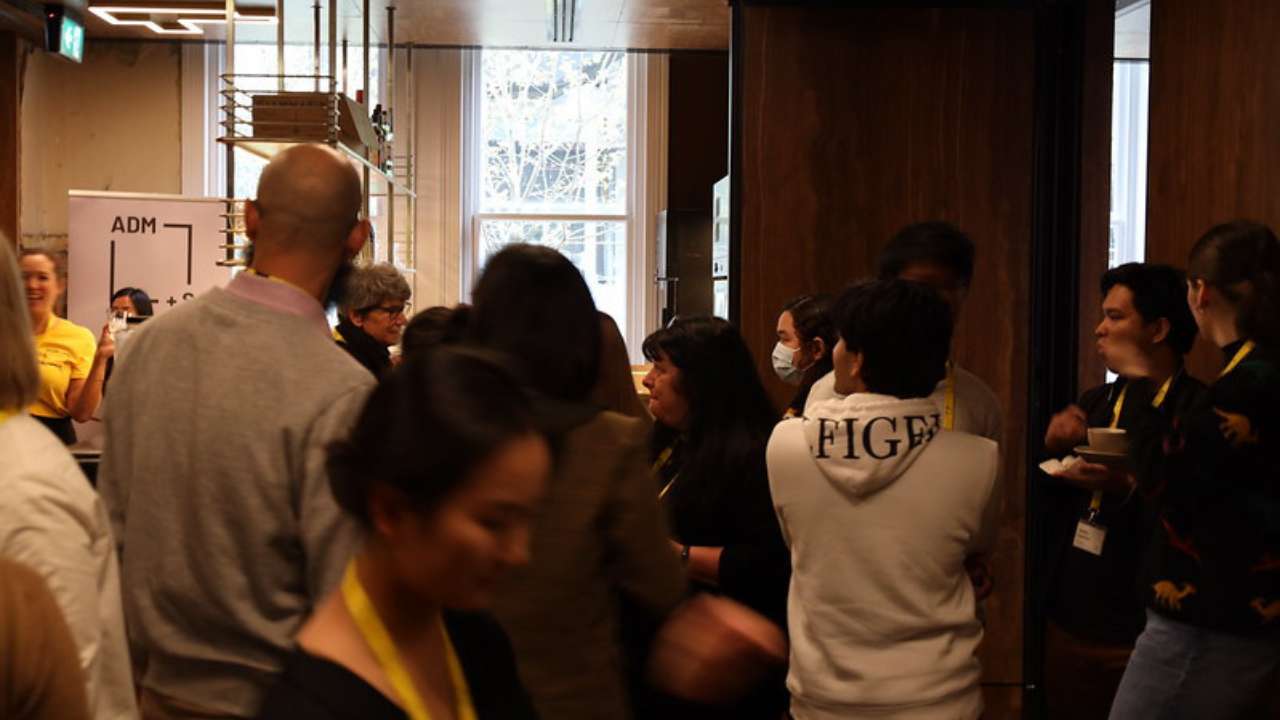
8.30am
Pre-Summer School Coffee Meet-Up
Seminar Rooms 1 & 2
Read More:
Description: This informal Pre-Summer School Coffee Meet-Up aims to provide HDR students with a welcoming, low-pressure environment to connect and engage before the formal program begins. Scheduled for the morning of the first day, before the official summer School welcome session, the meet-up offers students an opportunity to meet peers, share experiences, and feel part of the broader ADM+S HDR community.
Proposed outcomes for participants:
- Foster early social connections among HDR students
- Encourage wellbeing by promoting a relaxed and supportive start to the Summer School
- Introduce a new practice of regular, informal HDR coffee mornings
- Provide a space for students to raise ideas, issues or suggestions for the HDR Committee in an accessible and collegial setting. Ultimately, this initiative aligns with the HDR Committee’s 2026 goal which is to strengthen community, inclusion, and wellbeing among HDR students within ADM+S.
9.00am
Event Registration and Morning Tea
9.30am
HDR Survival Hacks: Thriving on your HDR Journey
Location: Storey Hall Lecture Theatre, (Downstairs), Building 16 (Storey Hall) – RMIT University
Presenters: Margaret Xiong and Ayesha Fernandes from RMIT Counselling and Psychological Services.
Read More:
Description: This presentation focuses on the emotional ups and downs of the HDR student experience, from staying motivated and managing stress to overcoming procrastination and quieting the inner critic. It aims to provide practical tools and insights to support wellbeing, connection, and long-term success in research.
ROOM 1 (HYBRID)
ROOM 2
10.45am
SESSION 01 (HYBRID)
Computer-Aided Ethnography: Using the Telescope bot and Obisidian vaults to innovate on method
Presenters: Kelsie Nabben, Ellie Rennie, Brooke Ann Coco, Luke Miller
Read More:
Description: The workshop details experiments we have been conducting in augmenting ethnographic practices with computational tools. This includes the ‘Telescope bot’, a data consent tool that actively engages participants in the research towards more ethical, living ethnographic practice, and how we are using the application Obsidian to structure, annotate, and share research data for a multi-sided, large data volume ethnography. These innovations sit in the context of the ADM+S project on ‘Artificial Organisational Intelligence’, which is about making organisation-level knowledge machine-readable so that it may be accessible and legible to humans through AI.
Proposed learning outcomes for participants: Workshop attendees can expect to reflect on and possibly innovate their own qualitative research practices, as well as the future of ethnography.
SESSION 02
Centering Cultural and Linguistic Diversity in Digital Technology Research: A Collaborative Inquiry
Presenters: Udiana Dewi, Jiaxi Hou, Patcharaper (Kate) Rojanakit
Read More:
Description: This interactive workshop convenes participants for a collective inquiry into cultural and linguistic diversity as an indispensable lens for understanding the invention, implementation, and usage of digital technologies. It opens by outlining the complex dimensions of diversity, arguing why non-dominant perspectives are essential, and introducing how updated qualitative methods offer essential toolkits for engaging with this diversity. Participants then move between one of the three thematic groups based on their primary concerns:
(1) navigating the cross-cultural field,
(2) grappling with messy ethics,
(3) translating less-acknowledged experiences.
In these facilitated group discussions, we will share common challenges and collaboratively explore solutions. A final roundtable discussion will feature three presenters sharing their actionable strategies on methodology, ethics, and representation, followed by participants highlighting key insights from their discussions.
Proposed learning outcomes for participants:
By the end of the session, participants will:
- Recognise the value of cultural and linguistic diversity when studying digital technologies
- Identify common challenges and exchange concrete strategies for navigating issues like access to the field, researchers positionality, and data translation
- Build connections for interdisciplinary support and collaboration
12.00pm
Lunch and Mentoring
12.00pm
Crochet and Knitting Circle
Seminar Rooms 3 & 4
Read More:
No experience needed. Tools and yarn will be provided.
You are also welcome to bring your own tools and yarn if you have them.
1.00pm
SESSION 03 (HYBRID)
Listening in to industry: A workshop on critical industry approaches
Presenters: Maria Gemma Brown, Meg Thomas, Thao Phan, Nicholas Carah and Christine Parker
Read More:
Description: This workshop and panel will centre on critical industry methodologies. Critical industry methodologies, according to media scholar J.T. Caldwell, studies industry texts, interviews and even trade shows as a form of insider knowledge and theorising. In sum, this approach examines the moments where an industry gives an account of itself. The purpose of the workshop is to outline the philosophy behind the method, demonstrate the research questions and problems it can be applied to, and outline the of methods involved. Even further we seek to emphasise the strength and usefulness of such a method for a variety of ADMS interest areas. In general, we believe by critically examining the discourses and imaginaries of particular industries, researchers can develop a meaningful understanding of society and culture.
Proposed learning outcomes for participants:
By the end of the session, participants will:
- Have a broad understanding of critical industry approaches
- Gain an in-depth understanding of key methods within this approach, including: how to contact and interview professionals, how to systematically collect and analyse grey literature and archival materials, and how to write field notes for a tradeshow ethnography
- Gain key insights from researchers’ experiences across a range of disciplines including STS, cultural studies, Film and TV, and legal studies
SESSION 04
What Does the Platform Know About Me? Exploring Your Digital Data Download Package (Part 1)
Presenters: Michael Esteban and Amanda Lawrence
Read More:
Resource: What Does The Platform Know About Me?
Description: This hands-on workshop invites participants to explore the data that online platforms collect about them via tools developed by the Australian Internet Observatory. Through guided activities, participants will learn how to request and download their personal data packages and gain practical experience using a tool to visualise, analyse, and reflect on their digital footprints. The session emphasises understanding digital privacy, data donation, and how online activities are tracked.
Proposed learning outcomes for participants:
By the end of the session, participants will be able to:
- Understand what a data download package is and the types of personal data platforms collect
- Understand how their online behaviour is tracked
- Learn how to access and download their own digital data package from an online platform
- Use the AIO platform tools to explore, analyse, and visualise their data
- Decide when and how DDPs can be utilised for collecting data for their own research
2.15pm
Afternoon Tea
2.45pm
SESSION 05
Translating research to children with the Centre for the Digital Child
Presenters: Henry Fraser, William He, Luci Pangrazio, Kristy Corser, Louise Paatsch
Read More:
Description: This workshop is intended to explore the possibillites of collaborating with the Centre for the Digital Child (an ARC CoE) to translate research to children, and to co-create outputs with children, for children. Children are often heavily impacted by digital technology and its governance – including in relation to social media, deepfakes, gaming, streaming platforms, AI, chatbots and other technologies. This workshop will introduce participants to the Centre for the Digital Child, and its work. It will present a case study of a current collaboration between ADM+S, Digital Child and QUT’s GenAI lab to create an interactive ‘explainer’ for children aged 6-10 about AI chatbot sycophancy. Participants will then spend the remaining hour of the workshop in a mini-hackathon, workshopping ideas on other artefacts, games, explainers and co-creation approaches to translate ADM+S research to children through collaboration with Digital Child.
Proposed learning outcomes for participants:
Participants will leave the workshop with a basic understanding of the work of our colleagues at Digial Child, the opportunities for collaboration with them, methods for developing research outputs for child audiences, and co-creation methods with children.
SESSION 06
Head Shots
Presenters: Matt Warren
Read More:
Description:
Does your profile photo need a refresh?
Stop by the ADM+S photo booth and update your head shot.
Location TBC
4.30pm
Capoeira Workshop
Alumni Courtyard, RMIT University, 357 Russell Street, Melbourne, 3000
Read More:
This activity aims to bring an introduction to Capoeira with a hands-on activity. Get ready to learn some Capoeira songs, play some percussion, do some basic Capoeira movements, and learn more about where Capoeira comes from and how is being currently practiced all around the globe. No previous experience nor musical/acrobatic skills are required (Capoeira is for everybody!). Capoeira (/kæpəʊˈeərə/) is an Afro-Brazilian cultural practice, an art form that involves sport, body expression, music, and tradition. Capoeira is a Tupi-Guarani word (same language as for “jacaranda” or “açaí”), which in Portuguese means “mato cortado” (in English, “cut bush”). Capoeira promotes mutual respect and inclusion between diverse individuals and communities, as well as the memory of resistance to historical oppression. Since 2014, the “roda de Capoeira” (Capoeira circula) has been inscribed on the Representative List of the Intangible Cultural Heritage of Humanity by UNESCO.
Note to delegates: It is recommended to bring a water bottle, a towel, and comfortable clothes/sportswear.