Can AI help the planet without harming it? International Summer School explores the future of ecocentric AI
Author ADM+S Centre
Date 16 July 2026
Artificial intelligence is increasingly being promoted as a tool to help address climate change, but how can AI help the planet without harming it?
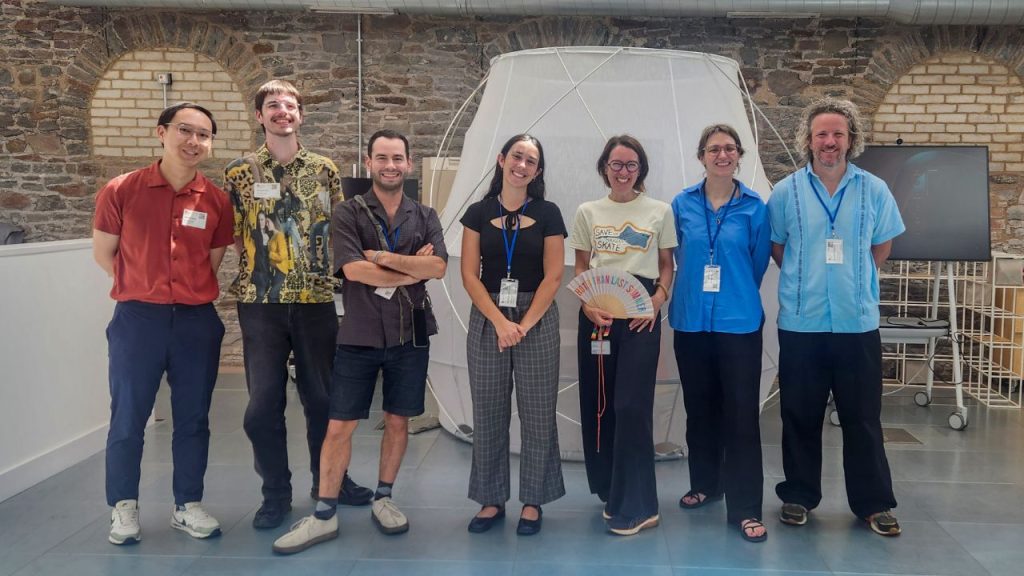
To explore this complex challenge, researchers from the ARC Centre of Excellence for Automated Decision-Making and Society (ADM+S) and the Bristol Digital Futures Institute (BDFI) brought together international experts, early career researchers and practitioners for the Ecocentric AI Summer School, a three-day program examining how automated technologies can contribute to climate action while acknowledging their own ecological footprints.
Organised by Partner Investigator Professor Melissa Gregg, Research Associate Will Hunter and ADM+S Research Training Manager Sally Storey, the Summer School marked the first major collaboration between ADM+S and BDFI, which recently joined ADM+S as an international Partner Organisation.
“The BDFI/ADM+S Summer School is a fantastic manifestation of what partner institutions can provide: young scholars gain beneficial exposure to broader academic conversations, and researchers in both regions share expertise to deepen the impact and significance of the topics being studied,” said Professor Melissa Gregg.
“The issue of AI and the environment could not be more urgent for this kind of global exchange.”
Participants heard from leading international experts and advocates who are actively working to reshape the relationship between AI, society and the environment.
Professor Tilo Burghardt, a leading expert in computer vision and animal biometrics at the University of Bristol, showcased pioneering research demonstrating how computer vision and AI can help monitor, understand and protect wildlife.
Professor Jennifer Gabrys, Chair in Media, Culture and Environment at the University of Cambridge challenged participants to think about how sensing technologies do more than observe environments, they actively impact how we understand, manage and respond to ecological change.
A key theme throughout the program was the need to consider AI not only as a tool for environmental action, but as a technology embedded within environmental systems, with its own resource demands, infrastructures and consequences.
Hannah Smith from the Green Web Foundation demonstrated her work helping technologists take action against climate change, supporting greener web infrastructure and reducing carbon impacts of digital products. Hannah shared her work holding global corporations to account for their environmental records, including the growing energy demands of AI and data centres.
Mary Stevens from Friends of the Earth UK, shared insights from the Greening AI initiative which identified 7 principles to guide environmental justice campaigners in developing an ethical approach to AI.
ADM+S researchers also contributed the following perspectives on eccentric AI from the ADM+S ADM, Ecosystems and Multispecies project.
- Associate Professor Michael Richardson presented Ecocentric AI: From Witnessing to Stewardship
- Dr Mardi Reardon-Smith shared work from A tale of two islands, a project using AI to experiment in the monitoring of feral cat eradications on inhabited islands.
- Dr Lina Przhedetsky discussed AI and automated decision-making in essential services markets as well as data governance challenges arising from use of AI in conservation.
- Dr Loup Cellard discussed the many barriers to waste heat reuse from data centres
To put these discussions into practice, participants worked together in a collaborative datathon, responding to real-world challenges posed by University of Bristol academics and BDFI partners.
Teams explored questions including how to map data centre infrastructure, how computer vision could support conservation efforts for Tasmania’s endangered forty-spotted pardalote, and how to communicate uncertainty in methane emissions data to policymakers, journalists and the public.
Recognising the importance of communicating research to public audiences, participants took part in a sensory ethnography workshop led by Mardi Reardon-Smith. Through film, sound and observation, participants explored new ways of representing relationships between technology, humans and the wider environment.
The workshop was an explicit offering co-listed with the University of Bristol’s Summer School in Environmental Humanities.
The Ecocentric AI Summer School highlighted the importance of ensuring automated technologies serve the environments in which they are deployed, to put the needs of other species and the planet as a whole in the foreground for why new technology investments are justified.
Following on from the summer school, researchers plan to continue prototyping solutions to challenges raised in the datathon, as well as building collective resources to advance advocacy on wildlife conservation and the health impacts of resource intensive digital infrastructure.