AI Use Case Design Cards

AI Use Case Design Cards

Multiple cards

Target Audience: Policy-makers

The AI Use Case Design Cards document real-world AI applications across a wide range of domains, highlighting their social, ethical and political implications.

PURPOSE

Designed for workshops,classrooms and strategy sessions, the cards support comparative analysis and pattern-finding across cases, helping users develop context-sensitive and informed policy and governance responses grounded in real examples.

Suggested citation: Khan, A. H., & Saarim, S. (2025). AI Use Case Design Cards. Carlton, VIC, Australia: ARC Centre of Excellence for Automated Decision-Making and Society. https://espace.library.uq.edu.au/view/UQ:760a7ae
AI Policy Design & Evaluation Digital Toolkit

AI Policy Design & Evaluation Digital Toolkit

Multiple cards

Target Audience: Policy-makers

This toolkit enables users to explore trade-offs, contradictions and unintended consequences in AI governance, supporting interdisciplinary learning and more nuanced, equitable policy development.

PURPOSE

This interactive digital toolkit supports critical policy design and evaluation through three integrated card suites: AI use cases, policy tools (based on the NATO framework), and key evaluation considerations.

Combined with wicked problem mapping, the toolkit enables users to explore trade-offs, contradictions and unintended consequences in AI governance, supporting interdisciplinary learning and more nuanced,
equitable policy development.

Suggested citation: Khan, A. H., & Saarim, S. (2025). AI Policy Design & Evaluation Toolkit. Carlton, VIC Australia: ARC Centre of Excellence for Automated DecisionMaking and Society. https://espace.library.uq.edu.au/view/UQ:055a3d

Trauma-Informed AI Assessment Toolkit

Trauma-Informed AI Assessment Toolkit

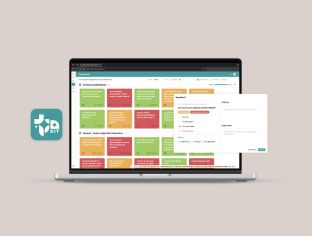
Laptop screen with coloured boxes

Target Audience: Social services organisations

The Trauma Informed Toolkit aids an organisation’s reflective process on how an algorithmic system may generate new trauma or re-traumatise, and how they may enhance the safety of their digital tools in service delivery.

PURPOSE

Building on work in social services on trauma-informed practice, researchers identified key principles and a practical framework that framed AI design, development and deployment as a reflective, constructive exercise that resulting in algorithmic supported services to be cognisant and inclusive of the diversity of human experience, and particularly those who have experienced trauma. This study resulted in a practical, co-designed, piloted Trauma Informed Algorithmic Assessment Toolkit.

This Toolkit has been designed to assist organisations in their use of automation in service delivery at any stage of their automation journey: ideation; design; development; piloting; deployment or evaluation. While of particular use for social service organisations working with people who may have experienced past trauma, the tool will be beneficial for any organisation wanting to ensure safe, responsible and ethical use of automation and AI.

This resource is part of the Critical Capabilities for Inclusive AI project.

Suggested citation: Henman, P., Fay, S., Sleep, S., Khan, A. H., Tran, D. K., Elvery, A., & Maitra, S. (2025). Trauma-Informed AI Assessment Toolkit. ARC Centre of Excellence for Automated Decision-Making and Society. https://www.tiakit.com/

RELATED PUBLICATIONS

Building a Trauma-Informed Algorithmic Assessment Toolkit

Maitra, S., Sleep, L., Fay, S., & Henman, P. (2026) Building a Trauma-Informed Algorithmic Assessment Toolkit. ARC Centre of Excellence for Automated Decision-Making and Society, University of Queensland and Central Queensland University.

Read the report

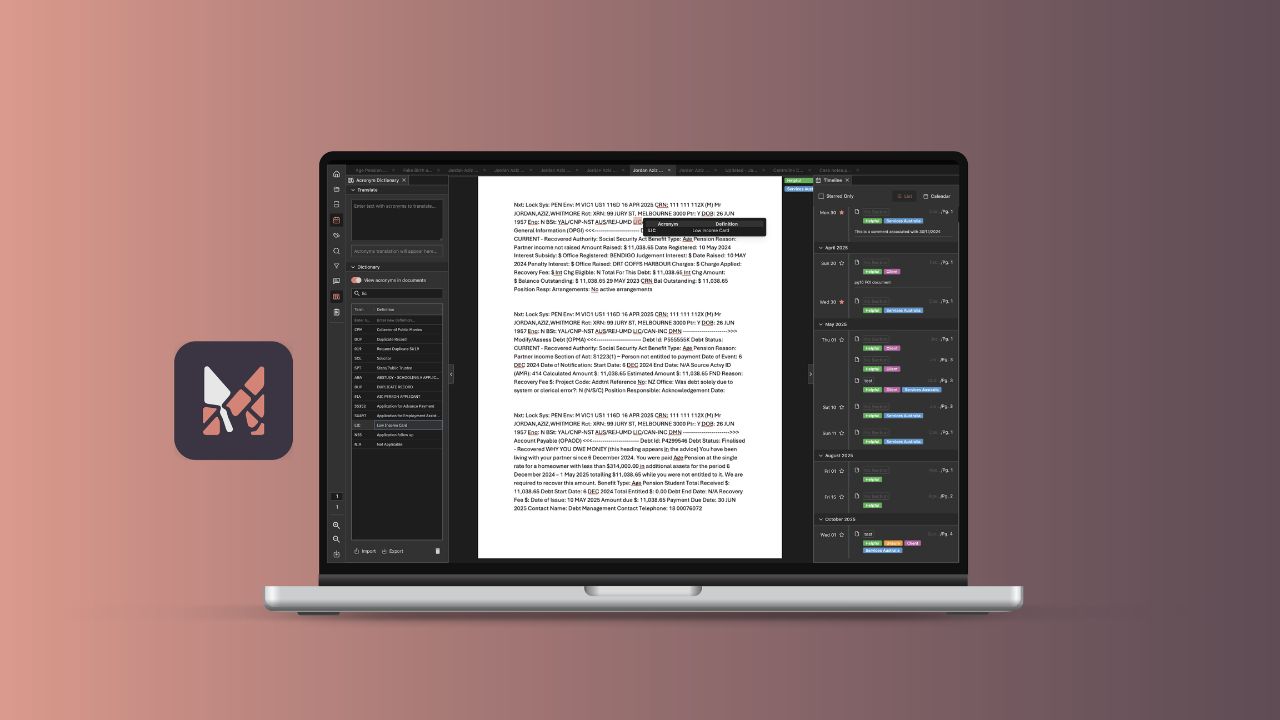
Mortar: Navigating and Sensemaking of Large Volumes of Client Documents and Case Files

Mortar: Navigating and Sensemaking of Large Volumes of Client Documents and Case Files

Laptop screen displaying text

Target Audience: Welfare rights lawyers, Advocacy groups

A digital desktop application created to support lawyers in managing, analysing and navigating large volumes of Services Australia (Centrelink) documents and client case files.

PURPOSE

Mortar is a desktop application that is developed to view Freedom of Information (FOI) documents, as part of the Designing Automated Tools to support Welfare Rights Advocacy project of the ARC Centre of Excellence for Automated Decision-Making and Society. It was designed and piloted in collaboration with welfare rights lawyers, advocacy groups, and social services users.

Suggested citation: Khan, A. H., Tran, D. K., Kelly, M., Karim, A. O., Henman, P., Wilcock, S., Singh, E., Casey, S., Mullins, R., Carney, T., Allingham, K., & Eagle. C. (2025). Mortar. ARC Centre of Excellence for Automated Decision-Making and Society. https://admscentre.github.io/mortar-release/download

The Data Detox Kit: Whose Voice is it Anyway?

The Data Detox Kit: Whose Voice is it Anyway?

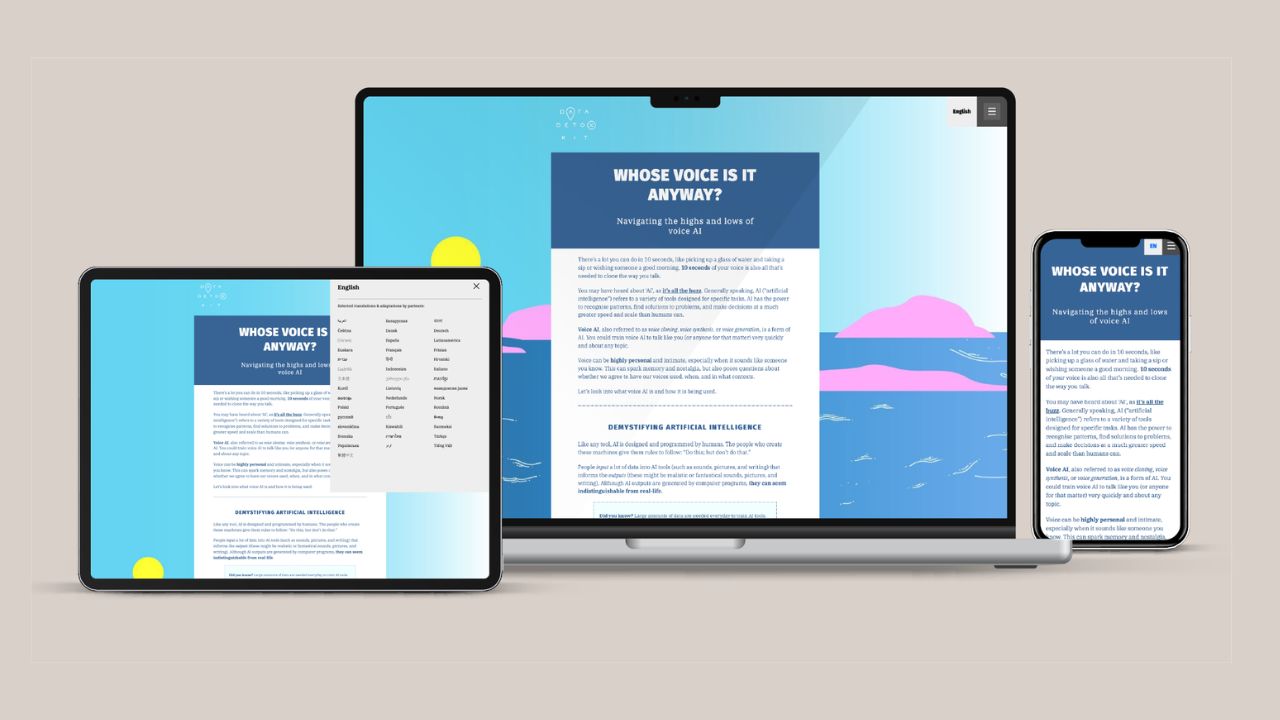
Screenshots of the Whose Voice is it Anway? website

Target Audience: General public

"Whose Voice is it Anyway?" is an interactive, self-guided resource designed to help people critically engage with emerging AI technologies, particularly voice-based systems.

PURPOSE

Part of the broader Data Detox Kit series, “Whose Voice is it Anyway?” offers accessible activities and practical guidance that build awareness of how AI tools
collect, interpret, and reproduce voices, as well as the potential risks around privacy, consent, and misuse. Available in 43 languages, the kit is designed for a global audience and supports users
to develop safer digital habits, better understand AI safety issues, and reflect on questions of identity,
ownership, and control in an increasingly AI-mediated world.

Suggested citation; Ghnaim, S., Carrigan, L., Hisayasu, L., Knoblochová. D., Carlon, D., Khan, A. H., & McCosker, A., (2025). Whose Voice is it Anyway? Data Detox Kit. Tactical Tech.

This research is part of the Critical Capabilities for Inclusive AI project.

Mapping the Digital Gap

Mapping the Digital Gap

Mapping the Digital Gap co-researcher Shalarna Thorpe conducting a survey with Tuvesi Williams in Wilcannia

Target Audience: General public, Government agencies, Researchers

The First Nations Digital Inclusion Dashboard is part of the ADII, is an interactive platform designed to provide detailed insights into how Aboriginal and Torres Strait Islander people access, use, and experience digital technologies across Australia.

PURPOSE

The First Nations Digital Inclusion Dashboard enables users to explore data on key dimensions of digital inclusion—access, affordability, and digital ability—across urban, regional, and remote communities, and to compare outcomes with non–First Nations populations. Drawing on survey data collected in partnership with First Nations organisations and communities, the dashboard offers a nuanced picture of the digital divide and the factors shaping it, while supporting measurement of progress towards Closing the Gap Target 17. Importantly, it is intended as a resource for First Nations communities, policymakers, and researchers to better understand barriers, inform culturally appropriate solutions, and strengthen digital inclusion in ways that support connection, culture, and self-determination.

This research is part of the Mapping the Digital Gap project.

RESEARCHERS

Distinguished Professor Julian Thomas

Prof Julian Thomas

Chief Investigator,
RMIT

Learn more

Lauren Ganley

Lauren Ganley

Head of First Nations Strategy & Engagement,
Telstra

Learn more

The Australian Digital Inclusion Index

The Australian Digital Inclusion Index

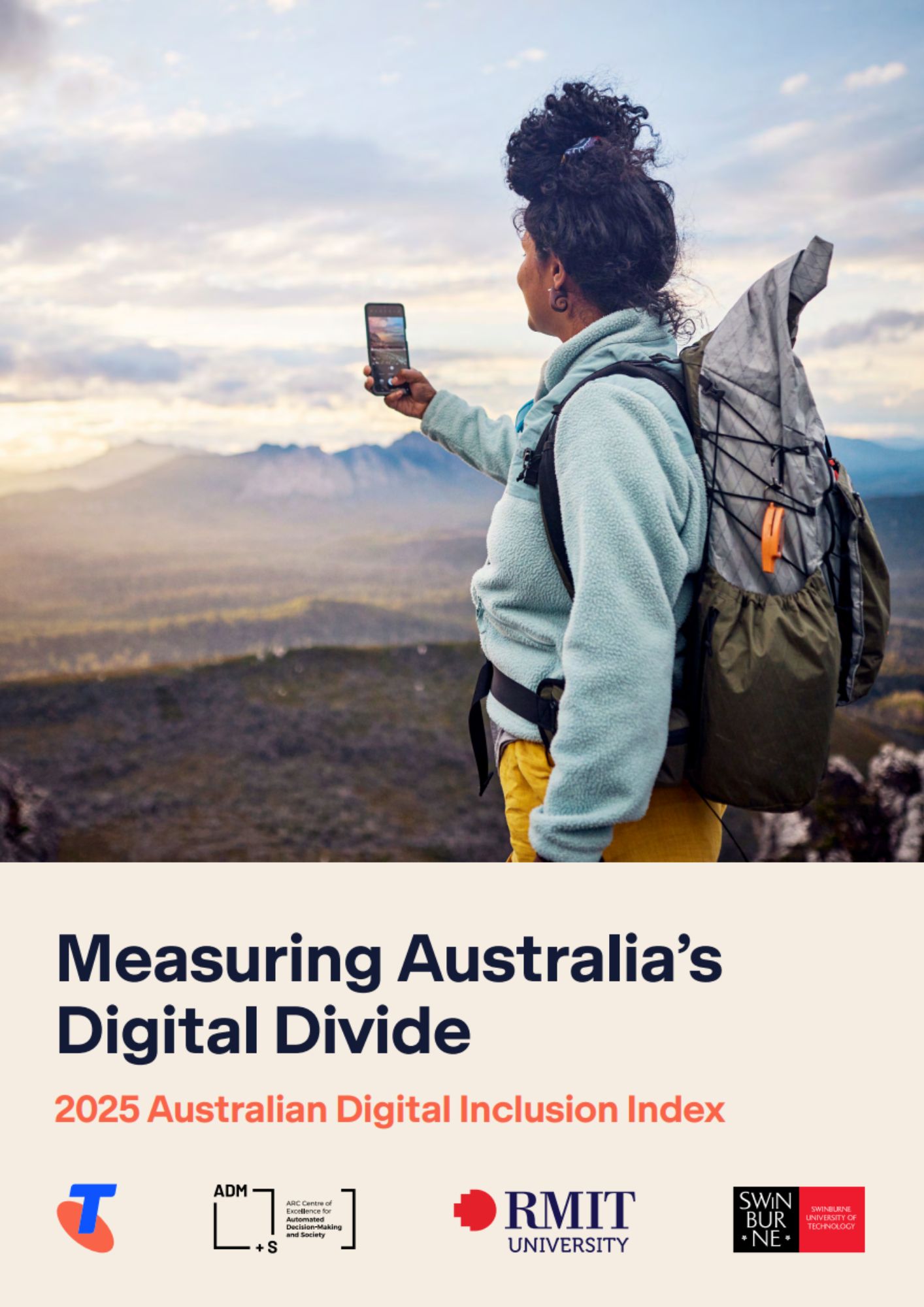
Bushwalking female, looking for phone reception from the top of a mountain in remote Tasmania, Australia.

Target Audience: General public, Government agencies, Researchers

The Australian Digital Inclusion Index uses data from the Australian Internet Usage Survey to measure digital inclusion across three dimensions of Access, Affordability and Digital Ability. We explore how these dimensions vary across Australia and across different social groups.

PURPOSE

The Australian Digital Inclusion Index (ADII) measures digital inclusion across three core areas: access, affordability and digital ability. It highlights disparities among regions and social groups, including First Nations Australians, and identifies key barriers to inclusion. Widely used by governments, businesses and community organisations the ADII informs strategies to improve digital access nationwide.

This research is part of the Australian Digital Inclusion Index project.

Recommended Citation: 2023 Australian Digital Inclusion Index. (2023). Interactive data dashboards. Telstra.

RELATED PUBLICATIONS

Measuring Australia's Digital Divide

Thomas, J., McCosker, A., Parkinson, S., Hegarty, K., Featherstone, D., Kennedy, J., Ormond-Parker, L., Morrison, K., Rea, H., & Ganley, L. Measuring Australia’s Digital Divide: 2025 Australian Digital Inclusion Index. Melbourne: ARC Centre of Excellence for Automated Decision-Making and Society, RMIT University, Swinburne University of Technology, nd Telstra.

Read the Report

RESEARCHERS

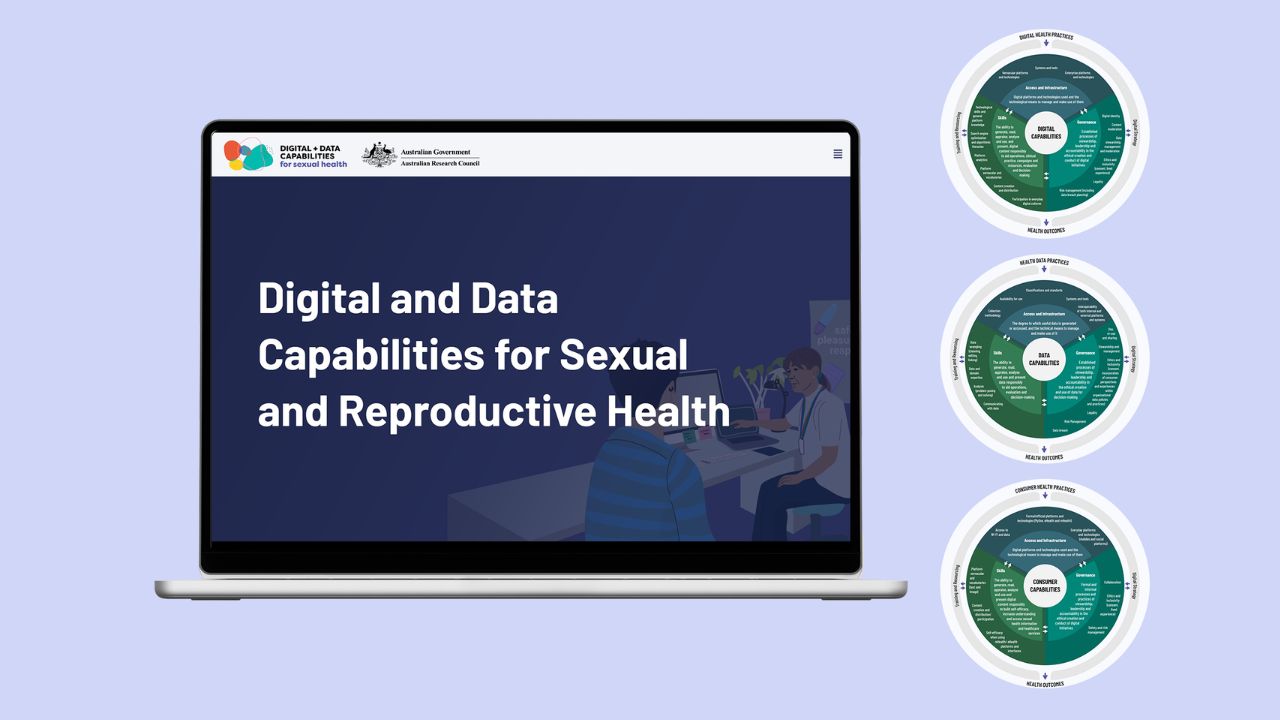
Digital and Data Capabilities for Sexual and Reproductive Health Website

Digital and Data Capabilities for Sexual and Reproductive Health Website

Target Audience: Sexual and reproductive health organisations and workforces

The Digital and Data Capabilities for Sexual and Reproductive Health website provides models and checklists to support digital transformation in sexual and reproductive health organisations and workforces.

PURPOSE

DDCSRH.com is a space for sexual and reproductive health organisations and their workforce to explore strategies for thinking about digital and data technologies in your organisation. These resources are informed by recent research, including interviews and workshops with sexual and reproductive health professionals and health consumers, and a review of relevant literature.

This website hosts three evidence-based models to support strategic conversations about digital transformation in sexual and reproductive health organisations and workforces.

  • Digital Capabilities for Sexual and Reproductive Health
  • Data Capabilities for Sexual and Reproductive Health
  • Consumer Capabilities for Sexual and Reproductive Health

The Digital and Data Capabilities for Sexual and Reproductive health Project is a 4-year programme of research led by Professor Kath Albury. It was funded by an Australian Research Council Future Fellowship.

This site based on two iterative stages of qualitative research. You can read more about these stages in our research reports:

The sexual and reproductive health sector increasingly engages with digital technologies – from health promotion on social platforms to telehealth to online STI testing. The ‘digital transformation of health’ has accelerated since COVID lockdowns, and so has the development of digital health policies. What does this mean for the Australian
sexual health and reproductive health workforce?

This website provides models and checklists to support digital transformation in sexual and reproductive health organisations and workforces.

The Digital and Data Capabilities models build on Data Capabilities research partnerships funded and partially funded by Swinburne’s Social Innovation Research Institute; the Lord Mayor’s Charitable Foundation and the ARC Centre of Excellence for Automated Decision-Making +Society. This research is part of the Critical Capabilities for Inclusive AI project.

Recommended Citation: Albury, K., Mannix, S., Learmonth, C. (2025). Digital and Data Capabilities for Sexual and Reproductive Health. https://ddcsrh.com/

RELATED PUBLICATIONS

Health Promotion International journal cover

Kath Albury, Samantha Mannix (2025). Digital determinants of sexual and reproductive health—workforce perspectives on digital and data literacies. Health Promotion International, Volume 40, Issue 2, April 2025.

Read the Journal Article

Sexuality Research and Social Policy journal cover

Albury, K., Mannix, S. From Digital Health Literacy to a Digital and Data Capabilities Approach to Sexual Health. Sex Res Soc Policy 23, 29–43 (2026).

Read the journal article

Digital and data capabilities for sexual health policy and practice

Albury, K. and Mannix, S. (2023) Digital and Data Capabilities for Sexual Health Policy and Practice: Stage One Report. July 2023. Melbourne: Swinburne University of Technology.

Read the report

Building digital and data capabilities

Albury, K., Mannix, S., Learmonth, C., Mills, X. and Arnot-Bradshaw, A. (2024). Building digital and data capability for sexual health Stage Two report: working with young adults (18-29). Melbourne: Swinburne University of Technology.

Read the report

WEBINARS

Digital and Data Capabilities: new models for sexual health policy and practice – Stage One Report Launch (2023), with Kath Albury, Samantha Mannix, Shelley Kerr and Son Vivienne.  

Watch the recording

Digital and data capabilities for sexual and reproductive health – what do young adults want from health service providers. – Stage Two Report Launch (2024), with Kath Albury and Samantha Mannix.  

Watch the recording

‘Re-framing digital sexual health: from individual literacies to workforce capabilities’ – presented by Kath Albury and Samantha Mannix at the UNSW Centre for Social Research in Health and the BBV & STI Research, Intervention and Strategic Evaluation Program (BRISE), November 2023.

Watch the recording

Digital Cultures and Sexual Health: research and practice roundtable – with, Kath Albury, Heather McCormack, Jennifer Power, Daniel Reeders and Andrea Waling, 2022.

Watch the recording

RESEARCHERS

GenAI Arcade: Explore, Play and Understand AI

GenAI Arcade: Explore, Play and Understand AI

GenAI Arcade website on laptop screen

Target Audience: General public, All ages

The GenAI Arcade is an interactive learning platform that helps people understand how generative AI works through hands-on games and activities. Designed for non-experts, it offers an accessible, balanced view of AI's capabilities, limitations and broader impacts, without relying on technical jargon or hype.

PURPOSE

The GenAI Arcade was built as a research-informed response to a gap in how people understand and learn about generative AI. It was created to:

  • Move AI literacy beyond passive explanation (e.g. articles or lectures) toward hands-on, experiential learning, where people understand AI by interacting with it directly
  • Reveal how AI systems actually behave in practice, including their limitations, inconsistencies, and dependence on contex, things that are often hidden by polished interfaces
  • Challenge dominant “framings” of AI coming from both big tech (over-simplified or promotional narratives) and public discourse (either overly technical or overly apocalyptic)
  • Support “situated capabilities” understanding, meaning that AI isn’t treated as having fixed abilities, but as something whose outputs change depending on prompts, design, and social context
  • Promote critical AI literacy, grounded in experimentation, where users can test assumptions and develop a more realistic understanding of what generative AI can and cannot do.

This research is part of the Generative Authenticity project. This tool was created by QUT’s GenAI Lab. If you want to learn more about the GenAI Arcade or the QUT GenAI Lab, contact genailab@qut.edu.au

Recommended Citation: Witzenberger, K., Burgess, J., He, W., & Snoswell, A. (2025). GenAI Arcade. QUT GenAI Lab. http://genai-arcade.net

RELATED PUBLICATIONS

Building situated capabilities: An introduction to the GenAI Arcade

Witzenberger, K., Burgess, J., He, W., & Snoswell, A. (2025). Building Situated Capabilities: An Introduction to the GenAI Arcade. SSRN

Read the Journal Article

RESEARCHERS